
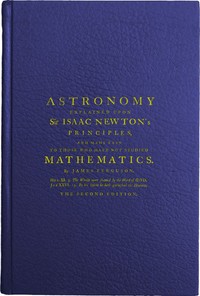
Astronomy Explained Upon Sir Isaac Newton's Principles by James Ferguson
Let's set the scene: it's the 1750s. Isaac Newton's revolutionary ideas about gravity and motion have shaken the intellectual world, but for most folks, they're just abstract, difficult theories. Enter James Ferguson. A Scottish shepherd's son with no formal schooling, he taught himself astronomy and became a master at building orreries—those incredible mechanical models of the solar system.
The Story
This book is Ferguson's masterclass. He doesn't just list facts about planets and stars. He starts from the ground up, asking you to imagine basic observations anyone could make. He then carefully, patiently builds on those observations using Newton's principles. Why do the planets move in ellipses? What really causes the tides? How can we predict a comet's path? He uses simple language, helpful diagrams, and comparisons to everyday experiences to demystify the universe's grand mechanics. The 'plot' is the journey of your own understanding, as Ferguson guides you from simple sky-watching to a genuine comprehension of the cosmic forces at play.
Why You Should Read It
What grabbed me wasn't just the astronomy, but Ferguson's voice. His excitement is contagious. You can feel his determination to share this knowledge, to prove that the wonders of science aren't locked away in ivory towers. He writes for the curious farmer, the interested merchant, the eager student. Reading his clear explanations of complex ideas, achieved without a single computer or space probe, is incredibly satisfying. It makes you appreciate the sheer genius of both Newton's discoveries and Ferguson's skill in teaching them. It turns the night sky from a pretty spectacle into a solvable puzzle.
Final Verdict
This is a gem for anyone who loves science history, great teaching, or just a fresh perspective. It's perfect for the popular science reader who wants to see where it all started, for the educator looking for a classic example of clear explanation, or for any stargazer who wants to feel the 'aha!' moment of understanding our place in the solar system, just as people did 270 years ago. It's not a quick modern read, but it's a profoundly rewarding one.
This title is part of the public domain archive. Feel free to use it for personal or commercial purposes.
Jessica Sanchez
4 months agoGreat read!





Lucas Anderson
6 months agoA bit long but worth it.