
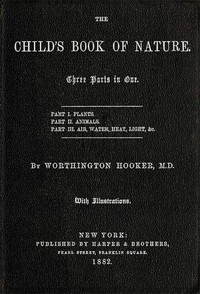
The Child's Book of Nature by Worthington Hooker
Let's clear something up right away: this isn't a novel. There's no villain to defeat or kingdom to save. Instead, Worthington Hooker sets out on a different kind of adventure—a tour of the completely ordinary, utterly extraordinary world right outside your door.
The Story
The 'story' is the story of nature itself, told in three parts. First, Hooker introduces us to plants. But he doesn't start with complicated diagrams. He starts with a seed in the soil and walks us through its life, asking us to consider how it eats, drinks, and grows. Then, he moves to animals, focusing on familiar creatures like birds, insects, and fish. He describes their habits and homes in clear, simple language. Finally, he looks at the air, water, and basic forces that shape our world. The whole book is built on questions a bright child might ask: Why do leaves change color? How does a spider spin its web? Where does the wind come from?
Why You Should Read It
Reading this book feels like sitting with a kind, incredibly knowledgeable grandfather. Hooker's voice is patient and full of genuine awe. What I love most is his method. He insists on direct observation. He's constantly saying, 'Go and see for yourself.' In an age of instant digital answers, this call to slow down and truly look is powerful medicine. The science is dated, of course—this was written before we understood genetics or plate tectonics—but the spirit of inquiry is timeless. You're not just getting facts; you're getting a mindset. It teaches respect for living things and a sense of place in a vast, interconnected system.
Final Verdict
This book is a treasure for specific readers. It's perfect for homeschoolers or parents looking for a gentle, literature-based introduction to natural science. It's a fantastic read-aloud for curious kids who love to ask 'why?' History of science buffs will appreciate it as a snapshot of 19th-century thought. And honestly, it's a lovely, calming read for any adult who needs a reminder to appreciate the small wonders. If you want cutting-edge facts, grab a modern encyclopedia. But if you want to rediscover the joy of asking questions, let Worthington Hooker be your guide.
You are viewing a work that belongs to the global public domain. Enjoy reading and sharing without restrictions.
Richard Martin
10 months agoHaving read the author's previous works, the level of detail in the second half of the book is truly impressive. Definitely a five-star contribution to the field.
Dorothy Hernandez
1 year agoSurprisingly enough, the storytelling feels authentic and emotionally grounded. Thanks for sharing this review.
Michelle Anderson
2 years agoThis book was worth my time since the storytelling feels authentic and emotionally grounded. Thanks for sharing this review.
Joshua Wilson
1 year agoCitation worthy content.



Mary Wilson
6 months agoThe digital formatting makes it very easy to navigate.