
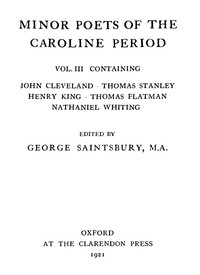
Minor Poets of the Caroline Period, Vol. III by George Saintsbury et al.
Let's be clear from the start: this isn't a novel. There's no single plot. 'Minor Poets of the Caroline Period' is a literary rescue mission. Think of it as a curated museum exhibit, but for words. Editor George Saintsbury and his team spent years in archives, finding poems that had been sitting untouched for centuries. This volume collects their finds – the work of men (and it is almost all men from this era) like Thomas Randolph, William Habington, and a dozen others you won't find in your standard poetry textbook.
The Story
There isn't a traditional narrative. Instead, the 'story' is the act of recovery itself. Saintsbury gives us a poet, provides a bit of context about their life (often just a few known facts), and then presents their work. You move from one voice to another: a love sonnet here, a religious meditation there, a witty satire on court life next. The through-line is the historical period – the reign of King Charles I, a time of growing political tension before the English Civil War. The poetry reflects that world: its elegance, its anxieties, its devotion, and its humor.
Why You Should Read It
I loved this book for the sense of discovery. It removes the pressure of reading 'The Greats.' You're not evaluating Milton; you're just listening. And in that listening, you find incredible moments. A perfect turn of phrase in a poem about a river. A shockingly personal line about doubt. It makes you realize how much art gets lost. Reading these 'minor' poets doesn't diminish the major ones; it adds depth to the whole era. You see the conversations they were all having. It’s also a quiet, slow read – perfect for dipping into for a poem or two before bed. It feels like a secret history of English literature.
Final Verdict
This is a niche book, but a rewarding one. It's perfect for curious poetry readers who feel they've exhausted the classics and want to explore the backroads of literary history. It's also great for anyone interested in the 17th century, as the poems are little windows into daily thought and feeling. If you need a fast-paced plot or famous names, look elsewhere. But if you enjoy the thrill of the hunt and don't mind that some poems are merely 'interesting' while others are genuinely beautiful, this collection is a unique and fascinating journey. It turns readers into archivists, and that's a special kind of magic.
This masterpiece is free from copyright limitations. It is available for public use and education.
Joseph Young
1 year agoGood quality content.
Jennifer King
1 year agoThe formatting on this digital edition is flawless.
Joshua Torres
7 months agoBeautifully written.
Jennifer Anderson
4 months agoI came across this while browsing and the flow of the text seems very fluid. Worth every second.
Melissa Flores
1 year agoThe index links actually work, which is rare!