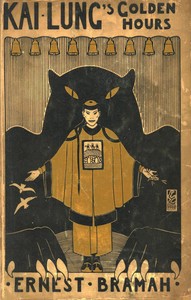
Kai Lung's Golden Hours — Context and Discussion

(0 User reviews)   49
In Category - Fantasy Classics
Bramah, Ernest, 1868-1942, Belloc, Hilaire, 1870-1953 [Author of introduction, etc.] Project Gutenberg 1998
Fantasy fiction; Kai Lung (Fictitious character) -- Fiction Readers of public-domain and historical texts
Project Gutenberg digital edition en

Edition facts

Words 87,299
Reading time 380 min
Text sections 15

Before opening Kai Lung's Golden Hours — Context and Discussion, the edition data offers a quick orientation: 87,299 words, 6 hr 20 min estimated reading time, and 15 detected text sections.

The text analysis averages about 25.7 words per sentence, while the detected sections provide another way to judge how the source is divided.

Project Gutenberg metadata also associates the work with “Fantasy fiction,” connecting these edition facts with the source record’s subject description.

Ernest Bramah's Kai Lung's Golden Hours presents the storyteller Kai Lung facing a trial of his art, where his tales must satisfy a skeptical audience. The prose is marked by ornate, mock-Chinese idioms, formal dialogue, and a framing narrative that pits wit against authority.
Share
Editorial Edition Score 4.8/5

Calculated from edition completeness, EPUB availability, text structure and catalogue metadata. Not a user rating.

How this score is calculated
  • Description quality20 pts
  • Title & short description10 pts
  • Source metadata20 pts
  • Text length15 pts
  • Chapters / structure15 pts
  • EPUB file integrity20 pts

Total of 100 points, scaled to a 2.5-5.0 range. Editions with an empty description or a missing EPUB file are not scored.

Edition quality

Read the Text

. Now that Fa Fai had attained an age when she could fittingly be sought in marriage the contingency might occur at any time, and the problem confronting her father’s decision was this: owing to her incomparable perfection Fa Fai must be accounted one of Wong Ts’in’s chief possessions, the other undoubtedly being his secret process of simulating the lustrous effect of pure gold embellishment on china by the application of a much less expensive substitute. Would it be more prudent to concentrate the power of both influences and let it become known that with Fa Fai would go the essential part of his very remunerative clay enterprise, or would it be more prudent to divide these attractions and secure two distinct influences, both concerned about his welfare? In the first case there need be no reasonable limit to the extending vista of his ambition, and he might even aspire to greet as a son the highest functionary of the province--an official of such heavily-sustained importance that when he went about it required six chosen slaves to carry him, and of late it had been considered more prudent to employ eight.

If, on the other hand, Fa Fai went without any added inducement, a mandarin of moderate rank would probably be as high as Wong Ts’in could look, but he would certainly be able to adopt another of at least equal position, at the price of making over to him the ultimate benefit of his discovery. He could thus acquire either two sons of reasonable influence, or one who exercised almost unlimited authority. In view of his own childlessness, and of his final dependence on the services of others, which arrangement promised the most regular and liberal transmission of supplies to his expectant spirit when he had passed into the Upper Air, and would his connection with one very important official or with two subordinate ones secure him the greater amount of honour and serviceable recognition among the more useful deities?

To Wong Ts’in’s logical mind it seemed as though there must be a definite answer to this problem. If one manner of behaving was right the other must prove wrong, for as the wise philosopher Ning-hy was wont to say: “Where the road divides, there stand two Ning-hys.” The decision on a matter so essential to his future comfort ought not to be left to chance. Thus it had become a habit of Wong Ts’in’s to penetrate the Outer Spaces in the hope of there encountering a specific omen.

Alas, it has been well written: “He who thinks that he is raising a mound may only in reality be digging a pit.” In his continual search for a celestial portent among the solitudes Wong Ts’in had of late necessarily somewhat neglected his earthly (as it may thus be expressed) interests. In these emergencies certain of the more turbulent among his workers had banded themselves together into a confederacy under the leadership of a craftsman named Fang. It was the custom of these men, who wore a badge and recognized a mutual oath and imprecation, to present themselves suddenly before Wong Ts’in and demand a greater reward for their exertions than they had previously agreed to, threatening that unless this was accorded they would cast down the implements of their labour in unison and involve in idleness those who otherwise would have continued at their task. This menace Wong Ts’in bought off from time to time by agreeing to their exactions, but it began presently to appear that this way of appeasing them resembled Chou Hong’s method of extinguishing a fire by directing jets of wind against it. On the day with which this related story has so far concerned itself, a band of the most highly remunerated and privileged of the craftsmen had appeared before Wong Ts’in with the intolerable Fang at their head. These men were they whose skill enabled them laboriously to copy upon the surfaces of porcelain a given scene without appreciable deviation from one to the other, for in those remote cycles of history no other method was yet known or even dreamed of.

“Suitable greetings, employer of our worthless services,” remarked their leader, seating himself upon the floor unbidden. “These who speak through the mouth of the cringing mendicant before you are the Bound-together Brotherhood of Colour-mixers and Putters-on of Thought-out Designs, bent upon a just cause.”

“May their Ancestral Tablets never fall into disrepair,” replied Wong Ts’in courteously. “For the rest--let the mouth referred to shape itself into the likeness of a narrow funnel, for the lengthening gong-strokes press round about my unfinished labours.”

“That which in justice requires the amplitude of a full-sized cask shall be pressed down into the confines of an inadequate vessel,” assented Fang. “Know then, O battener upon our ill-requited skill, how it has come to our knowledge that one who is not of our Brotherhood moves among us and performs an equal task for a less reward. This is our spoken word in consequence: in place of one tael every man among us shall now take two, and he who before has laboured eight gongs to receive it shall henceforth labour four. Furthermore, he who is speaking shall, as their recognized head and authority, always be addressed by the honourable title of ‘Polished,’ and the dog who is not one of us shall be cast forth.”

“My hand itches to reward you in accordance with the inner prompting of a full heart,” replied the merchant, after a well-sustained pause. “But in this matter my very deficient ears must be leading my threadbare mind astray. The moon has not been eaten up since the day when you stood before me in a like attitude and bargained that every man should henceforth receive a full tael where hitherto a half had been his portion, and that in place of the toil of sixteen gong-strokes eight should suffice. Upon this being granted all bound themselves by spoken word that the matter should stand thus and thus between us until the gathering-in of the next rice harvest.”

“That may have been so at the time,” admitted Fang, with dog-like obstinacy, “but it was not then known that you had pledged yourself to Hien Nan for tenscore embellished plates of porcelain within a stated time, and that our services would therefore be essential to your reputation. There has thus arisen what may be regarded as a new vista of eventualities, and this frees us from the bondage of our spoken word. Having thus moderately stated our unbending demand, we will depart until the like gong-stroke of to-morrow, when, if our claim be not agreed to, all will cast down their implements of labour with the swiftness of a lightning-flash and thereby involve the whole of your too-profitable undertaking in well-merited stagnation. We go, venerable head; auspicious omens attend your movements!”

“May the All-Seeing guide your footsteps,” responded Wong Ts’in, and with courteous forbearance he waited until they were out of hearing before he added--“into a vat of boiling sulphur!”

Thus may the position be outlined when Wei Chang, the unassuming youth whom the black-hearted Fang had branded with so degrading a comparison, sat at his appointed place rather than join in the discreditable conspiracy, and strove by his unaided dexterity to enable Wong Ts’in to complete the tenscore embellished plates by the appointed time. Yet already he knew that in this commendable ambition his head grew larger than his hands, for he was the slowest-working among all Wong Ts’in’s craftsmen, and even then his copy could frequently be detected from the original. Not to overwhelm his memory with unmerited contempt it is fitting now to reveal somewhat more of the unfolding curtain of events.

Wei Chang was not in reality a worker in the art of applying coloured designs to porcelain at all. He was a student of the literary excellences and had decided to devote his entire life to the engaging task of reducing the most perfectly matched analogy to the least possible number of words when the unexpected appearance of Fa Fai unsettled his ambitions. She was restraining the impatience of a powerful horse and controlling its movements by means of a leather thong, while at the same time she surveyed the landscape with a disinterested glance in which Wei Chang found himself becoming involved. Without stopping even to consult the spirits of his revered ancestors on so important a decision, he at once burned the greater part of his collection of classical analogies and engaged himself, as one who is willing to become more proficient, about Wong Ts’in’s earth-yards. Here, without any reasonable intention of ever becoming in any way personally congenial to her, he was in a position occasionally to see the distant outline of Fa Fai’s movements, and when a day passed and even this was withheld he was content that the shadow of the many-towered building that contained her should obscure the sunlight from the window before which he worked.

While Wei Chang was thus engaged the door of the enclosure in which he laboured was thrust cautiously inwards, and presently he became aware that the being whose individuality was never completely absent from his thoughts was standing in an expectant attitude at no great distance from him. As no other person was present, the craftsmen having departed in order to consult an oracle that dwelt beneath an appropriate sign, and Wong Ts’in being by this time among the Outer Ways seeking an omen as to Fa Fai’s disposal, Wei Chang did not think it respectful to become aware of the maiden’s presence until a persistent distress of her throat compelled him to recognize the incident.

“Unapproachable perfection,” he said, with becoming deference, “is it permissible that in the absence of your enlightened sire you should descend from your golden eminence and stand, entirely unattended, at no great distance from so ordinary a person as myself?”

“Whether it be strictly permissible or not, it is only on like occasions that she ever has the opportunity of descending from the solitary pinnacle referred to,” replied Fa Fai, not only with no outward appearance of alarm at being directly addressed by one of a different sex, but even moving nearer to Wei Chang as she spoke. “A more essential detail in the circumstances concerns the length of time that he may be prudently relied upon to be away?”

“Doubtless several gong-strokes will intervene before his returning footsteps gladden our expectant vision,” replied Wei Chang. “He is spoken of as having set his face towards the Outer Ways, there perchance to come within the influence of a portent.”

“Its probable object is not altogether unknown to the one who stands before you,” admitted Fa Fai, “and as a dutiful and affectionate daughter it has become a consideration with her whether she ought not to press forward, as it were, to a solution on her own account. . . . If the one whom I am addressing could divert his attention from the embellishment of the very inadequate claw of a wholly superfluous winged dragon, possibly he might add his sage counsel on that point.”

“It is said that a bull-frog once rent his throat in a well-meant endeavour to advise an eagle in the art of flying,” replied Wei Chang, concealing the bitterness of his heart beneath an easy tongue. “For this reason it is inexpedient for earthlings to fix their eyes on those who dwell in very high places.”

“To the intrepid, very high places exist solely to be scaled; with others, however, the only scaling they attempt is lavished on the armour of preposterous flying monsters, O youth of the House of Wei!”

“Is it possible,” exclaimed Wei Chang, moving forward with so sudden an ardour that the maiden hastily withdrew herself several paces from beyond his enthusiasm, “is it possible that this person’s hitherto obscure and execrated name is indeed known to your incomparable lips?”

“As the one who periodically casts up the computations of the sums of money due to those who labour about the earth-yards, it would be strange if the name had so far escaped my notice,” replied Fa Fai, with a distance in her voice that the few paces between them very inadequately represented. “Certain details engrave themselves upon the tablets of recollection by their persistence. For instance, the name of Fang is generally at the head of each list; that of Wei Chang is invariably at the foot.”

“It is undeniable,” admitted Wei Chang, in a tone of well-merited humiliation; “and the attainment of never having yet applied a design in such a manner that the copy might be mistaken for the original has entirely flattened-out this person’s self-esteem.”

“Doubtless,” suggested Fa Fai, with delicate encouragement, “there are other pursuits in which you would disclose a more highly developed proficiency--as that of watching the gyrations of untamed horses, for example. Our more immediate need, however, is to discover a means of defeating the malignity of the detestable Fang. With this object I have for some time past secretly applied myself to the task of contriving a design which, by blending simplicity with picturesque effect, will enable one person in a given length of time to achieve the amount of work hitherto done by two.”

With these auspicious words the accomplished maiden disclosed a plate of translucent porcelain, embellished in the manner which she had described. At the sight of the ingenious way in which trees and persons, stream and buildings, and objects of a widely differing nature had been so arranged as to give the impression that they all existed at the same time, and were equally visible without undue exertion on the part of the spectator who regarded them, Wei Chang could not restrain an exclamation of delight.

“How cunningly imagined is the device by which objects so varied in size as an orange and an island can be depicted within the narrow compass of a porcelain plate without the larger one completely obliterating the smaller or the smaller becoming actually invisible by comparison with the other! Hitherto this unimaginative person had not considered the possibility of showing other than dragons, demons, spirits, and the forces which from their celestial nature may be regarded as possessing no real thickness of substance and therefore being particularly suitable for treatment on a flat surface. But this engaging display might indeed be a scene having an actual existence at no great space away.”

“Such is assuredly the case,” admitted Fa Fai. “Within certain limitations, imposed by this new art of depicting realities as they are, we may be regarded as standing before an open window. The important-looking building on the right is that erected by this person’s venerated father. Its prosperity is indicated by the luxurious profusion of the fruit-tree overhanging it. Pressed somewhat to the back, but of dignified proportion, are the outer buildings of those who labour among the clay.”

“In a state of actuality, they are of measurably less dignified dimensions,” suggested Wei Chang.

“The objection is inept,” replied Fa Fai. “The buildings in question undoubtedly exist at the indicated position. If, therefore, the actuality is to be maintained, it is necessary either to raise their stature or to cut down the trees obscuring them. To this gentle-minded person the former alternative seemed the less drastic. As, however, it is regarded in a spirit of no-satisfaction--”

“Proceed, incomparable one, proceed,” implored Wei Chang. “It was but a breath of thought, arising from a recollection of the many times that this incapable person has struck his unworthy head against the roof-beams of those nobly-proportioned buildings.”

“The three stunted individuals crossing the bridge in undignified attitudes are the debased Fang and two of his mercenary accomplices. They are, as usual, bending their footsteps in the direction of the hospitality of a house that announces its purpose beneath the sign of a spreading bush. They are positioned as crossing the river to a set purpose, and the bridge is devoid of a rail in the hope that on their return they may all fall into the torrent in a helpless condition and be drowned, to the satisfaction of the beholders.”

“It would be a fitting conclusion to their ill-spent lives,” agreed Wei Chang. “Would it not add to their indignity to depict them as struggling beneath the waves?”

“It might do so,” admitted Fa Fai graciously, “but in order to express the arisement adequately it would be necessary to display them twice--first on the bridge with their faces turned towards the west, and then in the flood with their faces towards the east; and the superficial might hastily assume that the three on the bridge would rescue the three in the river.”

“You are all-wise,” said Wei Chang, with well-marked admiration in his voice. “This person’s suggestion was opaque.”

“In any case,” continued Fa Fai, with a reassuring glance, “it is a detail that is not essential to the frustration of Fang’s malignant scheme, for already well on its way towards Hien Nan may be seen a trustworthy junk, laden with two formidable crates, each one containing fivescore plates of the justly esteemed Wong Ts’in porcelain.”

“Nevertheless,” maintained Wei Chang mildly, “the out-passing of Fang would have been a satisfactory detail of the occurrence.”

“Do not despair,” replied Fa Fai. “Not idly is it written: ‘Destiny has four feet, eight hands and sixteen eyes: how then shall the ill-doer with only two of each hope to escape?’ An even more ignominious end may await Fang, should he escape drowning, for, conveniently placed by the side of the stream, this person has introduced a spreading willow-tree. Any of its lower branches is capable of sustaining Fang’s weight, should a reliable rope connect the two.”

“There is something about that which this person now learns is a willow that distinguishes it above all the other trees of the design,” remarked Wei Chang admiringly. “It has a wild and yet a romantic aspect.”

“This person had not yet chanced upon a suitable title for the device,” said Fa Fai, “and a distinguishing name is necessary, for possibly scores of copies may be made before its utility is exhausted. Your discriminating praise shall be accepted as a fortunate omen, and henceforth this shall be known as the Willow Pattern Embellishment.”

“The honour of suggesting the title is more than this commonplace person can reasonably carry,” protested Wei Chang, feeling that very little worth considering existed outside the earth-shed. “Not only scores, but even hundreds of copies may be required in the process of time, for a crust of rice-bread and handful of dried figs eaten from such a plate would be more satisfying than a repast of many-coursed richness elsewhere.”

In this well-sustained and painless manner Fa Fai and Wei Chang continued to express themselves agreeably to each other, until the lengthening gong-strokes warned the former person that her absence might inconvenience Wong Ts’in’s sense of tranquillity on his return, nor did Wei Chang contest the desirability of a great space intervening between them should the merchant chance to pass that way. In the meanwhile Chang had explained many of the inner details of his craft so that Fa Fai should the better understand the requirements of her new art.

“Yet where is the Willow plate itself?” said the maiden, as she began to arrange her mind towards departure. “As the colours were still in a receptive state this person placed it safely aside for the time. It was somewhat near the spot where you--”

During the amiable exchange of shafts of polished conversation Wei Chang had followed Fa Fai’s indication and had seated himself upon a low bench without any very definite perception of his movements. He now arose with the unstudied haste of one who has inconvenienced a scorpion.

“Alas!” he exclaimed, in a tone of the acutest mental distress; “can it be possible that this utterly profane outcast has so desecrated--”

“Certainly comment of an admittedly crushing nature has been imposed on this one’s well-meant handiwork,” said Fa Fai. With these lightly-barbed words, which were plainly devised to restore the other person’s face towards himself, the magnanimous maiden examined the plate which Wei Chang’s uprising had revealed.

“Not only has the embellishment suffered no real detriment,” she continued, after an adequate glance, “but there has been imparted to the higher lights--doubtless owing to the nature of the fabric in which your lower half is encased--a certain nebulous quality that adds greatly to the successful effect of the various tones.”

Ernest Bramah’s Kai Lung’s Golden Hours opens with a preface by Hilaire Belloc that praises the novel’s deliberate construction—a quality Belloc finds rare in modern English writing. The story itself centers on the itinerant storyteller Kai Lung, who must defend his life through the art of narrative. The excerpts reveal a work built on layered frames: Kai Lung’s tales are embedded within a larger plot involving his rival Ming-shu and the magistrate Shan Tien. The prose is consistently ornate, employing elaborate similes and a formal, almost ceremonial dialogue that mimics classical Chinese literary conventions. Bramah’s diction is precise and playful, with characters speaking in balanced, aphoristic phrases such as “Your virtuous little finger is as strong as Ming-shu’s offensive thumb.” This linguistic artifice is the book’s defining feature, shaping both its humor and its tension.

The Architecture of Framed Narratives

The excerpts show a story-within-a-story structure. Kai Lung’s survival depends on his ability to produce a tale on demand, a test arranged by Hwa-mei and the chief wife of Shan Tien. This framing device is not merely decorative; it creates a high-stakes context for each embedded story. The reader is constantly aware of the audience within the fiction—the characters who judge Kai Lung’s performance. Bramah uses this to comment on the nature of storytelling itself: the teller must gauge his listeners, adapt his material, and deliver under pressure. The frame also allows for shifts in tone, as the external plot (with its threats of execution) contrasts with the often whimsical or moralistic inner tales. This layered structure demands careful attention to who is speaking and why.

Diction and the Mock-Chinese Idiom

Bramah’s most distinctive authorial choice is his invented idiom, a stylized English that mimics translated Chinese classics. Characters speak in balanced couplets and proverbial constructions: “He measures with a golden rule,” or “The sun shines through his words and the moon adorns his utterances.” The dialogue is formal, even in moments of conflict. Hwa-mei’s challenge to the chief wife is couched in elaborate metaphors about jade rings and crystal charms. This consistent voice creates a self-contained world where every exchange feels ritualized. The effect is both comic and distancing—readers are never allowed to forget they are inside a constructed literary artifice. Bramah avoids modern colloquialisms entirely, maintaining the idiom even in moments of danger or deception.

Characterization Through Speech Patterns

Though the excerpts are limited, they reveal how Bramah differentiates characters through their speech. Kai Lung uses deferential, self-deprecating phrases (“This person has no fear”) and often speaks in proverbs. Hwa-mei is more direct and strategic, her words laced with irony: “Our lord’s trout were ever salmon.” The chief wife responds with measured loyalty, while the lesser wives are eager for entertainment. Even the absent Ming-shu is characterized by others’ descriptions of his “insatiable” and “degraded” nature. Bramah does not rely on physical description or interior monologue; instead, personality emerges from what characters say and how they say it. This technique aligns with the book’s oral storytelling theme, where voice is paramount.

Setting and the Yamen as Stage

The physical setting is sketched lightly but functions as a social stage. The yamen (a government office) is where power is negotiated through words. The excerpts mention “inner chambers,” “lesser ones” vying for favor, and a trial by storytelling. The setting reinforces the hierarchical society: Shan Tien is the judge, his wives have rank, and Kai Lung is a captive performer. Bramah uses the yamen to create a closed environment where every action has social consequences. The threat of execution is real, but the conflict is played out through verbal duels and cunning schemes. The setting thus becomes a pressure cooker for the narrative, forcing Kai Lung to rely on his wits and his tales.

Readers approaching Kai Lung’s Golden Hours should attend to the interplay between the frame story and the embedded tales. The pleasure of the book lies not in rapid plot advancement but in the texture of its language and the ingenuity of its storytelling contests. Bramah’s idiom rewards slow reading; each aphorism and simile is deliberately placed. The novel is best enjoyed as a performance, where the act of telling is as important as what is told.

I keep thinking about Kai Lung’s quiet defiance, how he spins elegance against blunt authority. It reminded me of the old tale where beauty softens something fierce—not by force, but patience. That same gentle stubbornness lives in Beauty and the Beast — Edition Insights, and I lingered there long after closing the page.

There are no reviews for this eBook.

0
0 out of 5 (0 User reviews )

Add a Review

Your Rating *
There are no comments for this eBook.

Reader reflection

What was your reading experience?

Capture what you thought, learned, and would like to remember.

Your progress 0 / 10
1

What is your current status with this title?

2

What was your overall reaction to the book?

3

Would you pass this book on to a friend?

4

How easy was the book to follow?

Related eBooks