1

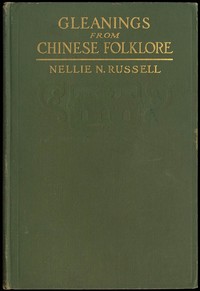
Gleanings from Chinese folklore — Text and Context
(0 User reviews)
3374
Project Gutenberg
2025
Not confirmed
Folklore -- China
Readers of public-domain and historical texts
Project Gutenberg digital edition
en
Edition facts
Words
38,708
Reading time
169 min
Text sections
5
Before opening Gleanings from Chinese folklore — Text and Context, the edition data offers a quick orientation: 38,708 words, 2 hr 49 min estimated reading time, and 5 detected text sections.
The text analysis averages about 21.1 words per sentence, while the detected sections provide another way to judge how the source is divided.
Project Gutenberg metadata also associates the work with “Folklore -- China,” connecting these edition facts with the source record’s subject description.
Source:
Project Gutenberg record #75089
This editorial note examines the authorial choices in Nellie N. Russell's collection of Chinese folklore, focusing on her narrative voice, use of direct address, and integration of personal missionary experience with traditional tales.
Editorial Edition Score
4.7/5
★★★★★
★★★★★
Calculated from edition completeness, EPUB availability, text structure and catalogue metadata. Not a user rating.
How this score is calculated
- Description quality20 pts
- Title & short description10 pts
- Source metadata20 pts
- Text length15 pts
- Chapters / structure15 pts
- EPUB file integrity20 pts
Total of 100 points, scaled to a 2.5-5.0 range. Editions with an empty description or a missing EPUB file are not scored.
Edition quality
Public-domain source text
Read the source text
The source text is kept in the dedicated reader, separate from this catalogue record and its commentary.
Nellie N. Russell's Gleanings from Chinese Folklore opens with a striking blend of personal memoir and traditional tale. The foreword, written by a colleague, describes Russell as someone who 'relived' the lives around her, a quality that permeates her storytelling. In the story 'How the Dog and Cat Came to Be Enemies,' Russell directly addresses her readers: 'Let me tell you the story, and as you listen possibly you can see the dear little children of the great flowery kingdom.' This choice to frame folklore within a conversational, almost intimate tone reveals a deliberate authorial strategy: she positions herself as a bridge between cultures, inviting Western readers to imagine Chinese domestic scenes.
Direct Address and Orality
Russell frequently breaks the fourth wall, using phrases like 'My young readers' and 'Can you not say with her?' This technique mimics the oral tradition of Chinese grandmothers telling stories to children, which she explicitly references: 'the old women of China love to tell their children and grandchildren.' By adopting a storyteller's voice, Russell transforms written text into a performed narrative. The effect is twofold: it creates immediacy and underscores the folkloric origin of the material. However, this choice also risks flattening cultural distance, as she assumes a shared moral framework with her audience.
Embedded Missionary Perspective
Russell does not separate her folklore from her missionary work. In the story of 'Literary Glory,' a convert killed during the Boxer Rebellion, Russell interjects: 'My young readers who have given your money for Bridgman School... does the result of your investment satisfy you?' This direct appeal to donors reveals the collection's dual purpose: entertainment and evangelical fundraising. The folklore is framed by Christian commentary, as when she speculates on 'Literary Glory's' heavenly name: 'Is it "Heavenly Glory"?' Such passages show Russell using folk narratives as vehicles for moral instruction, blending Chinese motifs with Protestant theology.
Diction and Cultural Translation
Russell's diction oscillates between colloquial English and translated Chinese idioms. She describes a gold ornament that produces food when a charm is repeated, a motif common in Chinese folklore. Yet she renders the charm in simple English: 'I want dumplings, meat dumplings. Come, dumplings, come.' This choice prioritizes accessibility over authenticity. Similarly, she uses Western analogies like 'Mother Goose' to explain the story's popularity. While this aids comprehension, it also domesticates the source material, potentially erasing cultural specificity. The compiler, Mary H. Porter, notes that the volume includes 'memorial sketches,' suggesting that the folklore is secondary to Russell's biography.
Structure and Compilation
The book is not a pure folklore collection but a hybrid: it combines traditional tales with personal narratives and memorial tributes. The foreword by Luella Miner and the dedication 'to Miss Russell's fellow-workers' indicate that the volume serves as a memorial. The folklore is interspersed with accounts of Russell's missionary work, such as the story of 'Literary Glory,' which is presented as a true account. This structure implies that the folklore is meant to illuminate Russell's character and her relationship with Chinese converts. The reader must navigate between genres, recognizing that the tales are filtered through a Western, Christian lens.
Readers should approach Gleanings from Chinese Folklore as a document of cross-cultural encounter rather than a pure ethnographic record. Russell's authorial choices—her direct address, missionary framing, and selective translation—reveal as much about her own worldview as about Chinese folklore. To appreciate the tales, one must attend to the editorial apparatus: the foreword, the memorial sketches, and the compiler's notes. These paratexts shape how the folklore is presented and received, making the book a rich subject for studying early twentieth-century American missionary literature.
Sometimes I think about how Nellie Russell must have felt, gathering those tales between her own life and the strangers' firesides. It reminds me of the quiet way another collection holds its ground, The Unwritten Literature of the Hopi — Story, Setting & Ideas, as if both books were simply listening. A particular ache lingers there, a kind of home-sadness, and I find myself returning to it more often than I expected.
There are no reviews for this eBook.
There are no comments for this eBook.
Reader reflection
How will you remember this book?
Save your reaction, strongest insight, and memorable passage.
Your progress
0
/
10
2
What was your overall reaction to the book?
3
Is this a title you would suggest to others?
4
How much effort did this book require?
5
Did any part of the book feel personally relevant?
6
Could you apply anything you learned?
7
Would you read this book again?
8
Was the book moving at the right speed?
9
What is the main idea you are taking away?
10