1

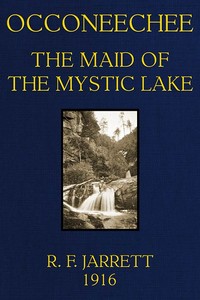
Occoneechee, the Maid of the Mystic Lake — Reading Notes
(0 User reviews)
795
Project Gutenberg
2016
Not confirmed
Cherokee Indians -- Folklore; Cherokee language -- Glossaries, vocabularies, etc.
Readers of public-domain and historical texts
Project Gutenberg digital edition
en
Edition facts
Words
62,036
Reading time
270 min
Text sections
14
Before opening Occoneechee, the Maid of the Mystic Lake — Reading Notes, the edition data offers a quick orientation: 62,036 words, 4 hr 30 min estimated reading time, and 14 detected text sections.
The text analysis averages about 22.7 words per sentence, while the detected sections provide another way to judge how the source is divided.
Project Gutenberg metadata also associates the work with “Cherokee Indians -- Folklore,” connecting these edition facts with the source record’s subject description.
Source:
Project Gutenberg record #53375
This editorial note examines the structure of Jarrett's 1916 work, which combines a narrative poem, Cherokee myths, and a glossary. It focuses on the interplay between verse and prose, recurring imagery of stone and transformation, and the movement from epic storytelling to ethnographic catalog.
Editorial Edition Score
4.8/5
★★★★★
★★★★★
Calculated from edition completeness, EPUB availability, text structure and catalogue metadata. Not a user rating.
How this score is calculated
- Description quality20 pts
- Title & short description10 pts
- Source metadata20 pts
- Text length15 pts
- Chapters / structure15 pts
- EPUB file integrity20 pts
Total of 100 points, scaled to a 2.5-5.0 range. Editions with an empty description or a missing EPUB file are not scored.
Edition quality
Read the Text
Sequoya was himself an untutored half-breed, yet to him are we indebted for an alphabet of 76 characters which stands third among the alphabets which have been invented among men, and by which a Cherokee child learns to read as fluently in six months of study as does the average English child in three years of study under our system.
The name Cherokee, so far as research reveals, has no meaning or the meaning has been lost or perhaps Anglicized, but we have authority for its use, for the past 375 years.
When De Soto's expedition was made through the Appalachian mountains, in 1540, he encountered this great and friendly nation living peacefully in their paradise among the hills and mountains, who received him as they were wont to receive a friendly tribe; so did they ever receive and treat the white neighbor until treaty after treaty had been broken and their homes had been destroyed and every compact violated.
Hostilities were in most cases caused by encroaching whites and broken promises and intrigues of the foreigners, who were gradually drawing the cordon around the diminishing tribe.
The battle of Horseshoe Bend, which took place in the Tallapoosa river, in Alabama, on the 27th day of March, 1814, was one of the notable events in Cherokee history, where Junaluska, in conjunction with General Jackson, slaughtered or massacred nearly one thousand Creeks, which ended the Creek war and brought much honor to Junaluska and his valiant Cherokee army of more than 500 men.
For the terrors which followed the battle of Horseshoe Bend, we have only to refer to history to be able to ascertain the facts concerning the bloody atrocities which were perpetrated upon an oppressed people. Then came the end, which occurred in the year 1838, which culminated in the removal of the band to the Indian Territory, which is now called Oklahoma, (a Choctaw word meaning red people, Okla, people; homa, red).
This removal was the most luckless and recreant of all the abuses that had been heaped upon the brave but helpless band of Cherokee.
Junaluska, who witnessed the removal, but was permitted to remain with the residue, remarked that had he known that General Jackson (who became President), would have removed the Cherokee in such a brutal manner, he would have killed him at the battle of Horseshoe Bend.
The history of the removal of the Cherokee, as told by James Mooney of the Department of American Ethnology, gleaned by him from eye witnesses and actors in the tragedy, may well exceed in weight of grief and pathos any other act in American history. Even the much sung song of the exile of the Arcadians falls far behind it in the sum of death and misery.
Under General Winfield Scott, an army of 5,000 volunteers and regular troops were concentrated in the Cherokee country, and by instruction from Washington, D. C., he was directed and gave orders to soldiers to gather all Indians to the various stockades, which had been previously prepared for their reception. From these posts, squads of soldiers were sent to search out, with rifle and bayonet, every small cabin which could be found within the ramifications and deep recesses of the great Appalachian range of mountains, and bring to the forts every man, woman and child to be found within the gates of the granite hills.
Families, while sitting peacefully at the noon-day meal; others while performing the matutinal ablution, were suddenly startled by the gleam of bayonets and with blows, curses and oaths from the men called soldiers, the Indians were driven like cattle from their humble homes down the rugged mountain paths, and their houses in many cases were burned and their small possessions destroyed, as the brave but defenceless Cherokee people looked on with that wonderful stoicism which no other race of men ever possessed.
Men were seized in the fields, women torn from the wheel and the distaff, and children frightened from the pleasures of play. The vandals who followed in the wake of the soldiery, looting and pillaging, burning and destroying, yet calling themselves civilized Christians, were such a band of outlaws as is seldom seen even among the most savage and barbaric races.
Even Indian graves were robbed of the silver pendants and other valuables which had been deposited with the dead. Women who were not able to go, were actually forced at the point of a bayonet to march with the same speed as men.
Robert Frank Jarrett's Occoneechee, the Maid of the Mystic Lake (1916) is a hybrid work that moves between verse narrative, prose myth collection, and lexical appendix. The book's four-part structure—a long poem titled after the heroine, a section of Cherokee myths, and a glossary—creates a deliberate shift in genre and voice. The preface frames the project as an act of cultural preservation: Jarrett writes that he was inspired to write the poem so that Cherokee myths, legends, and traditions 'may linger and be transmitted to the nations yet to come.' This editorial note examines how the work's structure, recurring images, and movement between scenes shape the reader's experience.
From Epic to Encyclopedia
The book's architecture is unusual. Part I, 'The Cherokee,' and Part II, 'Occoneechee,' form a narrative poem of several thousand lines. Part III, 'Myths of the Cherokee,' shifts to prose retellings of traditional stories, and Part IV is a glossary of Cherokee words. This progression from sustained verse to fragmented prose to lexical list mirrors a movement from storytelling to documentation. The poem itself is episodic, with descriptive passages of landscape—'Tuckaseigee Falls, above Dillsboro' and 'Sunset from Mt. Junaluska'—punctuating the action. The myths, by contrast, are self-contained tales, each with its own internal logic. The glossary then atomizes language into individual terms. The effect is a gradual reduction of narrative scale, from epic sweep to discrete units of meaning.
Stone, Skin, and Transformation
A recurring image cluster in the myths involves stone and hardened skin. The figure of Utlunta, or Spear-Finger, is described as having 'a skin as hard as a rock, that no weapon could wound or penetrate,' and a long, stony finger 'like an awl or spear-head.' This monster can also take on any shape, including that of a grandmother or a family member. The combination of stony invulnerability and shape-shifting creates a tension between fixity and fluidity. Another creature, Nunyunuwi, is called 'Stone-dress,' and the myth notes that Spear-Finger could 'easily lift and carry immense rocks, and could cement them together by merely striking one against another.' The stone motif recurs in place names like 'Tree Rock' and in the failed bridge of stone that lightning scattered. These images suggest a landscape where the boundary between the organic and the mineral is permeable.
Movement Across the Mountain Landscape
The myths are anchored in specific geographic locations in western North Carolina: Nikwasi (the mound near Franklin), Nantahala, the Great Smoky Mountains, Whiteside Mountain. The narrative movement often follows trails and gaps. Spear-Finger's favorite haunt is 'about the gap on the trail where Chilhowee Mountains come down to the river.' The Cherokee burn leaves off the mountains to gather chestnuts, and the smoke draws the monster. The story of the pitfall trap is set at Nikwasi, where a council is held. This grounding in named places gives the myths a topographic precision. The poem's illustrations—photographs of waterfalls, mountains, and the Indian Mound—reinforce this sense of a real, traversable landscape. The reader moves with the characters from ridge to river, from village to hunting ground.
The Glossary as a Threshold
The final section, a glossary of Cherokee words, functions as more than a reference tool. It invites the reader to return to the poem and myths with an awareness of the original language. Words like Utlunta and Nunyunuwi appear in the myths, and the glossary provides their meanings. This structure implies that the English text is a translation or mediation of an oral tradition. Jarrett's preface emphasizes that the work is meant to preserve Cherokee memory 'by its songs and the writings of its poets.' The glossary, then, is a key to that preservation, offering a way into the linguistic texture of the stories. It also marks a shift in authority: the poet-narrator gives way to the lexicographer, and the reader becomes a student of the culture.
Readers approaching Occoneechee may find it useful to move through the book in order, experiencing the poem's sustained rhythm before encountering the prose myths and glossary. Alternatively, one might begin with the myths to gain familiarity with the figures and places that populate the poem. The glossary rewards browsing: it turns the act of reading into an act of recovery. Jarrett's work is best understood not as a single narrative but as a layered archive, where verse, folklore, and language mutually illuminate one another.
Whenever I shelve Occoneechee, I think of its patient turn from story into catalogue, from living voice to quiet record. There’s a similar hush in Legends of Vancouver — Background and Themes, where myth and landscape hold each other gently. Both books remind me of stones warmed by sun—still, but never empty. They keep their secrets well.
There are no reviews for this eBook.
There are no comments for this eBook.
Reader reflection
How did this book work for you?
Your answers remain private and are stored only in this browser.
Your progress
0
/
10
2
How much did you enjoy the reading experience?
3
Would you recommend this book to another reader?
4
How demanding did the text feel?
5
Could you apply anything you learned?
6
Could you follow the author’s main argument?
7
Was the book moving at the right speed?
8
Did you relate to its people, ideas, or situations?
9
In one sentence, what did you learn?
10