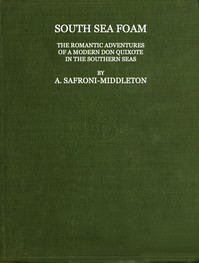
South Sea Foam The romantic adventures of a modern Don Quixote in the southern seas — Context and Discussion

(6 User reviews)   1632
In Category - Folklore
Safroni-Middleton, A. (Arnold), 1873-1950 Project Gutenberg 2019
Polynesia; Folklore -- Polynesia Readers of public-domain and historical texts
Project Gutenberg digital edition en

Edition facts

Words 109,390
Reading time 476 min
Text sections 24

South Sea Foam The romantic adventures of a modern Don Quixote in the southern seas — Context and Discussion can be approached with a clearer sense of reading commitment from its source measurements: 109,390 words, 7 hr 56 min estimated reading time, and 24 detected text sections.

The text analysis averages about 21.1 words per sentence, while the detected sections provide another way to judge how the source is divided.

Project Gutenberg metadata also associates the work with “Polynesia,” connecting these edition facts with the source record’s subject description.

A 1920 memoir blending South Seas adventure with Polynesian folklore, as the author recounts encounters with chiefs and characters like Fae Fae, while retelling legends such as Kasawayo and the serpent-god Buli-buli.
Share
Editorial Edition Score 4.9/5

Calculated from edition completeness, EPUB availability, text structure and catalogue metadata. Not a user rating.

How this score is calculated
  • Description quality20 pts
  • Title & short description10 pts
  • Source metadata20 pts
  • Text length15 pts
  • Chapters / structure15 pts
  • EPUB file integrity20 pts

Total of 100 points, scaled to a 2.5-5.0 range. Editions with an empty description or a missing EPUB file are not scored.

Edition quality

Read the Text

Author’s Heritage—Arrives at Samoa—Disillusioned—Illusive Romance—Golden-skinned Polynesian Maids—Meets great Heathen Philosophers—The Samoan Chief, O Le Tao

CHAPTER II. TROUBADOURING IN TAHITI 49

I ship with a genuine Old-time Crew—Poetic Nightmares—Tattooed Manuscripts of the Seas!—I learn the Art of Forcible Expression—Tar-pots—The Storm—Washed Overboard—Papeete—Pokara—How the first Coco-nuts came—Star Myths

CHAPTER III. POKARA’S STORY 92

Pokara tells me how the first Idol came to be Worshipped

CHAPTER IV. I MEET ALOA 100

The Hut in the Mountains—A Modern Fairy—The Escape—Love’s Hospitality—The Stranger from the Infinite Seas!

CHAPTER V. FAE FAE 106

I meet O’Hara—The Emotional Irish Temperament—The Tahitian Temperament—O’Hara and I go Pearl-hunting—Tapee, the Old-time Idol-worshipper

CHAPTER VI. ABDUCTION OF A PRINCESS 115

O’Hara in Love—Fae Fae’s Midnight Elopement—Chased—A Melodramatic Race for Life—The Innocence of Eve—Temptation—The Lost Bride—The Madness of Romance—Outbound for Honolulu

CHAPTER VII. THE HEATHEN’S GARDEN OF EDEN 144

Tangalora the Samoan Scribe—Where the Gods and Goddesses first met in Council—The Materials of which the first Mortal Children were Fashioned—The first Wondering Men—The first Women—How the first Babies came to their Mothers

CHAPTER VIII. IN OLD FIJI 158

A Heathen Monastery—A Scene of Primitive Heathenism—My unsolicited Professional Engagement—I imbibe Kava—I am made “Taboo”—Things that I may not Confess—My Escape—Fanga Loma—A Native Village—The Enchantress of the Forest—Temptation—In Suva again

CHAPTER IX. KASAWAYO AND THE SERPENT 175

(A FIJIAN LEGEND FOR YOUNG AND OLD CHILDREN)

A Goddess in the Garb of Mortality—A Garden of Eden—Temptation—Kasawayo and Kora the Mortal—The Battle Flight to Shadowland

CHAPTER X. O LE LANGI THE PAGAN POET 203

A Pagan Poet—Influence of Byron and Keats—Star-myths Enchanted Crab

CHAPTER XI. R. L. S. IN SAMOA 214

O Le Langi’s Influence—Heathen Magic—Poetic Aspirations—Ramao and Essimao-Samoan Types—Robert Louis Stevenson and the “Beautiful White Woman”—O Le Langi becomes a Part of the Forest—“Here lies O Le Langi”—A Great Truth

CHAPTER XII. A MOHAMMEDAN BANQUET 238

A Child of American Democracy—Rajah Barab—Barbarossa—Brown-Slave Traffic Methods—Motavia’s Grave—The Magic Casement—The Splendour of Rose-coloured Spectacles—Mohammedanistic Desires—Giovanni’s Love Affairs—Exit Barab

CHAPTER XIII. AN OLD MARQUESAN QUEEN 254

In Tai-o-hae—I come across a widowed Marquesan Queen—Am received with Dignity—The Artistic Tattoo on Loi Vakamoa’s Royal Person—The Queen tells how she was married to a certain Martin Smith of New South Wales—An aged Queen’s Vanity—A Heathen Necropolis

CHAPTER XIV. TISSEMOA AND THE CUTTLE-FISH 265

Impressionistic Scene in Nuka Hiva—Tissemao listens to the Luring Voice of a Cuttle-fish—The Love-stricken Cuttle-fish—When Crabs are Brave

CHAPTER XV. CHARITY ORGANIZATION OF THE SOUTH SEAS 273

I fall from Space—Court Violinist—Arrive in Fiji—With the Great Missing

CHAPTER XVI. YORAKA’S DAUGHTER 287

The Wild White Girl—The Wagner of Storms—A Pagan Citadel—Pagan Democracy—Ye Old Britisher—A Battle in the Dark

CHAPTER XVII. SOOGY, CHILD OF POETRY 318

Poetry’s Legitimate Child—Music’s Fairyland—A Civilized Old Man of the Sea—A Clerical Hat is the Symbol of Modern Religion

CHAPTER XVIII. RETROSPECT 326

The Modern Old Man of the Sea—Fifty Pounds!—A Human Octopus—Adrift at Sea—Sorrow—Saved—In Tonga—Our Old Man’s last Hiding-place—Retrospect

------------------------------------------------------------------------

TO YOU MEN OF THE CITIES

Come! follow me o’er the sun-bleached sands by the seas where the small grog-shanty stands On the Wallaby track to Falaboo. Come! drink of the sunsets, rich old wine from the wandering sinful days of mine, For ’tis only in dreams the world rings true. Come! dream of some magic, far-off day, some lone backyard in the Milky way! I’ll fiddle; how the wandering stars will dance! We’ll sing together—“Yo ho! yo ho!” as on the mighty God-winds blow Through the dreams of my world of gay romance.

I’ve tramped the tracks to Malabo, I’ve been the way the fallen go! When times were bad my fiddle wailed their grief— Till, by the camp-fires on the steep, one by one they fell asleep: (I’ve buried three, dead in their boots beneath The breadfruit trees, with all their dreams and Heaven knows what thwarted schemes!) We’d tramped the cities, then we sought the huts. And now?—secure on heathen isles, my pals still sport their hopeful smiles: We’re looking thin on rum and coco-nuts!

So read these pioneer strains of mine, and drink deep, friend, as men do wine, Of sunsets on the ocean’s foaming rim, Of far-away and long ago where the scented trade winds blow Till skylines sigh the stars full to the brim! As on I tramp through sun-parched days or camp beside the trackless ways, Here with my fiddle in the jungle curl’d,

Weighed down with wealth!—my tropic seas, my roof of stars above palm trees, My home the hills and highways of the world! But—if you men of far-off towns have got a few spare old half-crowns, Just buy my book, it’s really not the worst Man ever wrote, but nearly so, and that’s quite near enough, you know; So, be my friend—and read it “till you burst.”

------------------------------------------------------------------------

------------------------------------------------------------------------

CHAPTER I. SAMOA: FIRST IMPRESSIONS

Author’s Heritage—Arrives at Samoa—Disillusioned—Illusive Romance—Golden-skinned Polynesian Maids—Meets great Heathen Philosophers—The Samoan Chief, O Le Tao.

I’d fiddled in Australia, lived on cheek, Cursed all the gold-fields ever found down South, Lived with mosquitoes down by Bummer’s Creek— To say the least, I’d felt down in the mouth. I’d tramped the seaboard cities with my fiddle To make my fortune, but ne’er solved the riddle. I’d got quite thin on nuts and grins and smiles, So emigrated to the South Sea Isles— That Eldorado where men yawned and seemed to make their piles!

EVEN the wind, my boon companion—for are we not both born roamers?—seems to blow chunks of old memories through the moonlit, tossing pines that are sighing to-night outside this wayside inn. It’s here that we rest awhile, my fiddle and I, as I take up my pen to record some of the incidents from my early travels. Time, in its everlasting hurry, gives me the briefest space to say all I wish to say; and ere the month ends I shall be, once more, outbound on the western ocean.

Personally, I think that to have inherited a pair of rose-coloured spectacles from one’s ancestors is to have been endowed at birth with inexhaustible wealth, as well as being born a king in one’s own right. Such an inheritance enables one to conjure up the finest illusions, helps one to surmount apparently impossible heights, and also cheers one in each inevitable precipitous fall. I’ve often blessed the fates in the thought that they so kindly enabled me to warm my hands and heart by an imaginary fire when the winds were blowing cold. So much would I say, in complete humbleness, about my special gift. Possibly the aforesaid gift is the only inherited privilege that entitles me to write this book dealing with my life and travels in the South Seas. So far as the world’s and my own opinion goes, I’ve no violent claim to write more than three books. For, true enough, it does not make for notoriety and a keen interest in one’s self from a wide public to have done the things that I’ve done. I seriously doubt if my effigy will be seen in Madame Tussaud’s waxwork show when I come to die. The plain fact is, that it is not considered highly respectable to have slept in a wharf-dustbin in a strange land, unashamed, and with the lid on! And to have knelt in the complete obeisance of idolatry before a wooden idol with a tattooed heathen poet, and deliberately worshipped at the old shrine of the stars, is, to say the least, _not quite the thing_. Neither does a wandering vagabond life, and a deep feeling of kinship with strange old shellbacks, ragged derelicts, and tattooed chiefs, lay a suitable foundation for recording one’s omissions and sins in polite form. However that may be, I believe that to have dined deeply on salt-horse and weevily hard-tack, and to have played the fiddle on the “Wallaby track” from Maoriland to the Solomon Isles, is to have gathered an outfit of dire accomplishments that I hope may have inspired me with something to say.

First of all, I will say that, though I had been smashing about the seaports from Shanghai to Callao, and had trekked across the Never-Never land, generally bound for Nowhere, I still had strange hopes that wild pioneer life and romance, as I had read about it ere I ran away to sea, existed somewhere in the world. I was down in the dumps, stranded in Sydney, when the great opportunity presented itself. By the wharf, in the harbour, lay a three-masted ship. When I went aboard I heard that she was bound for the South Sea Islands—the Isles of the Blest!

“Any chance of a job?” I said to the chief mate. He solemnly shook his head, then critically scanned me, then pointing towards the cuddy aft, referred me to the skipper. Entering the gloom of the cuddy’s small alley-way, I bumped up against the “Old Man.”

“Any chance of a job, sir?” I murmured in my very best longing-for-work voice. The skipper stood stroking his whiskers, and, after scrutinizing me from head to feet, demanded to see my discharges.

“Git yer traps and come aboard.”

I was engaged as a member of the crew.

Next day we were towed down the harbour by a tug, and by midnight had a steady wind on the quarter, which took us out with all sails set into the Pacific.

It was a monotonous, long voyage. The “Saga,” for that was the name of the ship, wasn’t a “Cutty Sark” or a “Thermopylae” for speed.[1] Anyway, the length of the voyage helped to warm my ardent longing to arrive at the palmy coral isles.

The “Cutty Sark” and “Thermopylae” were two of the fastest sailing ships running from London to Sydney. The author sailed before the mast from Sydney to San Francisco on the “Cutty Sark.”

I think I was the happiest member of the crew when, after much buffeting with wild weather and stinking pork and maggoty hard-tack, our old wind-jammer hugged the outer reefs of the Samoan Isles. Ah, the music of the long-drawn sounds of the surges beating over the barrier reefs! I half fancied I could hear the palms sighing lyrical melodies as the winds crept like overflowing zephyrs from some great scented dream across that pagan world. On the dim blue horizon rose ranges of mountains, apparently touching the tropic sky: they were, to me, the peaks of romance!

The dry tongues of the aged, seasoned sailors hung out as they rubbed their tarry hands and sniffed the distant grog-saloon. Old M’Dougal, the ship’s carpenter, danced a jig and looked human for the first time. The Dutch boatswain pulled his red beard, gave a terrific grin in the moonlight, and muttered something about “Voomen and vine.” Then I got my few belongings together, packed my violin carefully, and was ready to go ashore.

It was quite dark when I found myself being rowed, or rather paddled, ashore in an outrigger canoe. As I went gliding by the moon-ridden lagoons, I felt that at last I had surely entered some magical harbour of a fairy-land.

Even when sunrise came like a silent crash of liquid gold over the wide Pacific, touching the mountain peaks and the scattered bee-hive-shaped huts of the forest townships, I was not disillusioned. All seemed as I had so fondly anticipated; it was as I had read about it all. Men yarned and argued dogmatically as they stood, fierce-eyed, before the bar of the wooden grog-shanty; there they stood, attired in large slouched hats, telling such mighty things about their thrilling travels that even old Homer, could he have heard, might well have sighed with envy!

When dusk came and I heard the tribal drums beating the stars in far away up in the forest villages, I thought, “Here at least I shall find rest from the hot-footed turbulency of civilized humanity; here I can dwell beneath the Eden-like shades of feathery palms, and listen to the wind-blown melodies as they come in from the sea and run across the island trees.” I revelled in such like thoughts. I felt that I had come across a pagan world where no more should I hear servile mumblings of a conventional people. I would peer into savage bright eyes and listen to the poetic lore of people who worshipped at the shrine of the stars and counted their days by the fading moons. But when the fierce-eyed, tattooed chief, leaning on his war-club before the rough customers of the grog-shanty’s bar, looked straight into the eyes of an old shellback, and, bringing his club down with a crash, said, with much vehemence, that he preferred Solomon’s Songs to the second chapter of the Corinthians, I rubbed my eyes and thought I dreamed! My chagrin was immense; those delectable palm-clad isles of primitive lore and romance had come under the blighting influence of civilization and of missionaries!

I was in Apia, Samoa, R. L. S., attired in his velvet coat, walked into the bar-room and then suddenly said, “Damn!” when the Beachcomber trod on his toe, bowed, and said, “Beg pawden, soir!” I strolled afar and discovered that bright-eyed babies, nestling at the bosoms of their shaggy-haired, handsome mothers, slept as “safe as houses” in doorless, small-thatched dens under the moonlit palms. And, wandering on, I saw star-eyed, nymph-like girls with tossing, coral-dyed hair, pass and repass me on the lonely forest track, singing merrily in a musical tongue as they dived once more into the shadows of the coco-palms.[2] All this was extremely pleasing. But one may imagine how my tenacious illusions were grossly shattered when the majestic ex-king Malaetoa of the proud _O Le Solu_ Dynasty, last of his ancient line, followed me into the isolated grog-shanty hard by, gazed into my eyes with fondest affection, and said, “Mine’s a bitter!”

The Samoans are not tawny or mahogany-coloured, but are of a pleasing, golden-skinned hue, sometimes fairer than Europeans.

Nevertheless adventure abounded. Those semi-savage men sang weird soulful songs, melodious ballads, about half-forgotten legends, and battles long ago; and their love-songs were as pleasing as the beauty and innocence of their womenkind. I roamed those palm-clad shores for days, and was considerably enlightened in an educational way, for I came across clans of strange old heathens, who seemed to me to be the disciples of the one true transcendent democracy. They were semi-naked heathen philosophers, old men clad in loin-cloths only. My pleasure was immense when I observed them sitting by their coral cave doors, solemnly chewing nuts, apparently as happy as the sunny, livelong day. It was sunset, and when they all commenced to beat their drums violently, beating the stars in, it seemed that their hoarse, quaintly musical voices, wailed out, “Behold! we are the people! Creation hath nobly toiled through the ages till, lo! the blessed sun warms our aged bones as nature casts into our trembling hands digestible nuts and sweet-scented taro!”

Could I help liking the companionship of such happy, wise old philosophers?

Many of those old-time natives were endowed with wonderful poetic intellect. And I vow that such an intellect my old Samoan friend, O Le Tao, possessed. I came across Tao about three weeks after arriving in Upolu. And I may say, that though I’ve played the fiddle under a palm tree outside a barbarian queen’s royal seraglio, and have been given the _Freedom of the pagan city_ in consequence, I can recall no one who was more hospitable to me than O Le Tao. And so, before proceeding with the wild life and adventures which I experienced after leaving Samoa for Tahiti, I would like just to touch on O Le Tao’s character and genius by the way. In fact, O Le Tao was interesting, if only on account of his physiognomy, which strangely resembled the weird scenery of Samoa by moonlight—scenery that I feel is an eminently suitable background for introducing him, and not in an impressionistic sketch either, but just as I knew him in his meditative old age.

First, I would tell you that it was a lovely sight to see the tropical orange flush of evening fade to a deep, fairy-like green on the sea’s horizon beyond the scimitar-shaped bay off Apia. Then, one by one, the stars peeped out, not down from the sky, but wistful-like up from the lagoons along the shore. It was an Olympian scene and one that I should imagine would inspire the most unimaginative observer. The native villages were silent; the mountains, like mighty sentinels staring out to sea, stood with tangled forest beards, sighing down to their rugged knees. Moonlit lines of palms waved like majestic plumes against the crystalline skies; a falling star seemed a pale ember blown out of the far-off constellations. But for the tiny pagan city of huts, nestling as it were in the crevice of the mountain’s hip, it might have been an uninhabited island world. Far down in the lower regions, in the vicinity of the mountain’s vast feet, a canoe was paddled out from the hairy growths between those mighty toes. It was a savage, wrinkled old man of another age, paddling off for the silent waters in a canoe, that was, to him, a small argosy bearing him away to the wonders of shadowland! But it wasn’t as weird as all that; it was simply the Samoan chief, O Le Tao, stealing away under the cover of night to one of the neighbouring islets, so that he might worship his hidden idol. Though I cannot claim to have been there on that special night, I well know it was none other than O Le Tao. And how I know this is my own secret. Possibly I’ve been a heathen too, and have prostrated myself before an idol; I’m queer enough for anything. However that may be, I recall that I met O Le Tao next day. I was travelling along in the vicinity of Mount Vala. I had just had an appetizing meal of Bass’s Ale and monkey-nuts—and was feeling in good humour. Coco-palms, breadfruits, and other picturesque trees sheltered me from the hot sunlight and my banana-leaf socks hardly swished as I softly trod the beautifully woven carpet of flower and fern that Nature’s patient hand had spread across the forest floor. The sea breeze swept pungent whiffs, like iced wine, to my nostrils, as I followed the track made by soft-footed savages for ages. Suddenly I was startled by seeing a frizzly, partially bald head protrude through the bamboos. It was O Le Tao’s cranium.

“What you wanter here?” he said.

“Talofa! e maloto ea oe” (I greet you, comrade, and hope you are well), I responded, as the chief’s brow puckered up with suspicion.

“What you gotter there—moosic?”

“Yes,” I responded, as he eyed my violin.

“No; I’m a friend,” I replied, as I handed him a mark. This largesse changed his aggressive look into a broad smile of welcome. Following him, I entered his hut. I sat on his best mat and drank refreshing coco-nut milk. Suddenly we were disturbed by hearing loud grunts, heavy breathing, and smashing of twigs. In another moment an aged Samoan woman entered the hut. She was a fine-looking old woman, and had kind eyes. She was carrying a huge calabash of water beneath one arm. Its cumbersome weight did not deter her from further efforts—in the other hand she held a coco-nut, a basketful of fish—all alive O!—on her back a bunch of bananas, and between her teeth two fishing rods. She was O Le Tao’s industrious better half. She too made me welcome. Then pretty Cenerita, their daughter, arrived. She had pretty hair, and eyes that outshone the gleams of the three coco-nut-oil lamps, hanging from the hut’s low roof that night; for it all ended in O Le Tao asking me to stay the night with them.

Arnold Safroni-Middleton’s South Sea Foam (1920) presents itself as a memoir of youthful wanderings, yet its subtitle—The Romantic Adventures of a Modern Don Quixote in the Southern Seas—signals a self-conscious literary framing. The preface immediately complicates the book’s genre: the author insists he does not claim to have “sought to redress wrongs done to beauteous dusky maidens,” yet he embraces the Quixote comparison. This tension between adventure narrative and folkloric collection shapes the entire work.

The catalog subjects list “Polynesia” and “Folklore—Polynesia,” but the excerpts reveal a hybrid text. One substantial passage recounts the legend of Kasawayo, a goddess who must hide from her mortal lover Kora after making a vow to the serpent-god Buli-buli. The story is told in a heightened, poetic style—complete with songs—that differs markedly from the preface’s conversational tone. This suggests the book alternates between personal anecdote and retold myth, a structure the author acknowledges when he notes that all written folklore undergoes “inevitable transmutation.”

The Author’s Stated Method

In the preface, Safroni-Middleton directly addresses how he handles Polynesian legends. He admits that his retellings use “my own order of intelligence” to recreate what primitive minds might have believed. This is not a claim of ethnographic accuracy; rather, he accepts that myths are “poetic babblings” transformed by each narrator. He compares Polynesian lore to that of “ancient Finns, Hindoos, Babylonians,” arguing that all written myths are “completely transformed.” This methodological note is rare in adventure memoirs and suggests the author wants readers to view the legends as literary recreations, not transcriptions.

The preface also names specific characters—Fae Fae, Soogy, Fanga—who appear to be real people he met. Yet the excerpted legend of Kasawayo and Kora features no such figures; it is a self-contained myth. The book thus seems to juxtapose two modes: the picaresque adventures of the author and his companions, and the embedded folklore of the islands. The preface’s frankness about transformation invites scrutiny of how these two strands relate.

The Kasawayo Legend: Style and Substance

The longest excerpt presents the story of Kasawayo, a goddess who promises the serpent-god Buli-buli to avoid mortals. She hides in the forest, singing to her beloved Kora while resisting the urge to reveal herself. The prose is ornate: “the forest winds put out their spirit fingers, lifted her masses of hair tenderly.” Songs are quoted in full, with lines like “Oh, love of my life, like unto the stars.” This is not the language of a travelogue but of romantic fantasy.

Several details recur: the moo-moo flowers, the ndrala-trees, the O Le maun oa (nightingale). These terms are left untranslated or glossed parenthetically, creating a sense of local color. The plot hinges on a vow and a transformation—Buli-buli becomes a serpent so Kasawayo can go alone. The story ends mid-scene, with Kasawayo still hidden. Without the full book, it is unclear whether this legend is completed or interrupted by the author’s own narrative.

Catalog Subjects vs. Actual Content

The Project Gutenberg record classifies South Sea Foam under “Polynesia” and “Folklore—Polynesia,” but the excerpts show a work that is as much about the author’s persona as about folklore. The preface’s Don Quixote framing and the disclaimer about not rescuing maidens suggest a self-mocking tone absent from the legend. The folklore, meanwhile, is presented in a distinct voice—mythic, song-filled, and morally unambiguous (a vow must be kept).

Notably, the catalog does not list “Adventure” or “Memoir,” yet the subtitle and preface clearly promise adventure. The folklore label fits the Kasawayo excerpt, but the book’s structure may be closer to a collection of tales within a travel frame. Readers expecting straightforward folklore may be surprised by the author’s personal interjections; those seeking adventure may find the myths slow. The catalog’s omission of “autobiography” or “travel” is a significant gap.

The excerpts from South Sea Foam reveal a work that resists easy categorization. Readers should approach it as a layered text: the author’s prefatory remarks provide a lens through which to view the legends, but the legends themselves may stand as independent creations. Pay attention to shifts in tone between the conversational preface and the lyrical myths. The book’s value lies not in ethnographic accuracy but in its self-aware blending of personal adventure and folkloric imagination.

I remember evenings with South Sea Foam, its narrator chasing half-heard legends through coral air. Years later, I found that same patient wonder in The Legendary History of the Cross A Series of Sixty-four Woodcuts from a Dutch Book Published by Veldener, A.D. 1483 — A Closer Reading. Both are quiet acts of faith—telling what the sea, or the old carvers, whispered once. They rest together on my shelf like old friends who never met.

Matthew Young
2 weeks ago

John Sanchez
1 week ago

William Allen
2 weeks ago

Anthony Jackson
3 weeks ago

Anthony Garcia
1 month ago

4.5
4.5 out of 5 (6 User reviews )

Add a Review

Your Rating *
There are no comments for this eBook.

Reader reflection

Your personal reading reflection

Build a private reading journal entry for this title.

Your progress 0 / 10
1

Where are you in your reading?

2

How much did you enjoy the reading experience?

3

Would you recommend this book to another reader?

4

Did the language feel accessible?

Related eBooks