1

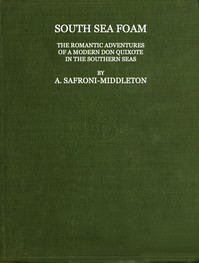
South Sea Foam The romantic adventures of a modern Don Quixote in the southern seas — Context and Discussion
(0 User reviews)
1670
Project Gutenberg
2019
Not confirmed
Polynesia; Folklore -- Polynesia
Readers of public-domain and historical texts
Project Gutenberg digital edition
en
Edition facts
Words
109,390
Reading time
476 min
Text sections
24
South Sea Foam The romantic adventures of a modern Don Quixote in the southern seas — Context and Discussion can be approached with a clearer sense of reading commitment from its source measurements: 109,390 words, 7 hr 56 min estimated reading time, and 24 detected text sections.
The text analysis averages about 21.1 words per sentence, while the detected sections provide another way to judge how the source is divided.
Project Gutenberg metadata also associates the work with “Polynesia,” connecting these edition facts with the source record’s subject description.
Source:
Project Gutenberg record #60385
A 1920 memoir blending South Seas adventure with Polynesian folklore, as the author recounts encounters with chiefs and characters like Fae Fae, while retelling legends such as Kasawayo and the serpent-god Buli-buli.
Editorial Edition Score
4.9/5
★★★★★
★★★★★
Calculated from edition completeness, EPUB availability, text structure and catalogue metadata. Not a user rating.
How this score is calculated
- Description quality20 pts
- Title & short description10 pts
- Source metadata20 pts
- Text length15 pts
- Chapters / structure15 pts
- EPUB file integrity20 pts
Total of 100 points, scaled to a 2.5-5.0 range. Editions with an empty description or a missing EPUB file are not scored.
Edition quality
Read the Text
Author’s Heritage—Arrives at Samoa—Disillusioned—Illusive Romance—Golden-skinned Polynesian Maids—Meets great Heathen Philosophers—The Samoan Chief, O Le Tao
CHAPTER II. TROUBADOURING IN TAHITI 49
I ship with a genuine Old-time Crew—Poetic Nightmares—Tattooed Manuscripts of the Seas!—I learn the Art of Forcible Expression—Tar-pots—The Storm—Washed Overboard—Papeete—Pokara—How the first Coco-nuts came—Star Myths
CHAPTER III. POKARA’S STORY 92
Pokara tells me how the first Idol came to be Worshipped
CHAPTER IV. I MEET ALOA 100
The Hut in the Mountains—A Modern Fairy—The Escape—Love’s Hospitality—The Stranger from the Infinite Seas!
CHAPTER V. FAE FAE 106
I meet O’Hara—The Emotional Irish Temperament—The Tahitian Temperament—O’Hara and I go Pearl-hunting—Tapee, the Old-time Idol-worshipper
CHAPTER VI. ABDUCTION OF A PRINCESS 115
O’Hara in Love—Fae Fae’s Midnight Elopement—Chased—A Melodramatic Race for Life—The Innocence of Eve—Temptation—The Lost Bride—The Madness of Romance—Outbound for Honolulu
CHAPTER VII. THE HEATHEN’S GARDEN OF EDEN 144
Tangalora the Samoan Scribe—Where the Gods and Goddesses first met in Council—The Materials of which the first Mortal Children were Fashioned—The first Wondering Men—The first Women—How the first Babies came to their Mothers
CHAPTER VIII. IN OLD FIJI 158
A Heathen Monastery—A Scene of Primitive Heathenism—My unsolicited Professional Engagement—I imbibe Kava—I am made “Taboo”—Things that I may not Confess—My Escape—Fanga Loma—A Native Village—The Enchantress of the Forest—Temptation—In Suva again
CHAPTER IX. KASAWAYO AND THE SERPENT 175
(A FIJIAN LEGEND FOR YOUNG AND OLD CHILDREN)
A Goddess in the Garb of Mortality—A Garden of Eden—Temptation—Kasawayo and Kora the Mortal—The Battle Flight to Shadowland
CHAPTER X. O LE LANGI THE PAGAN POET 203
A Pagan Poet—Influence of Byron and Keats—Star-myths Enchanted Crab
CHAPTER XI. R. L. S. IN SAMOA 214
O Le Langi’s Influence—Heathen Magic—Poetic Aspirations—Ramao and Essimao-Samoan Types—Robert Louis Stevenson and the “Beautiful White Woman”—O Le Langi becomes a Part of the Forest—“Here lies O Le Langi”—A Great Truth
CHAPTER XII. A MOHAMMEDAN BANQUET 238
A Child of American Democracy—Rajah Barab—Barbarossa—Brown-Slave Traffic Methods—Motavia’s Grave—The Magic Casement—The Splendour of Rose-coloured Spectacles—Mohammedanistic Desires—Giovanni’s Love Affairs—Exit Barab
CHAPTER XIII. AN OLD MARQUESAN QUEEN 254
In Tai-o-hae—I come across a widowed Marquesan Queen—Am received with Dignity—The Artistic Tattoo on Loi Vakamoa’s Royal Person—The Queen tells how she was married to a certain Martin Smith of New South Wales—An aged Queen’s Vanity—A Heathen Necropolis
CHAPTER XIV. TISSEMOA AND THE CUTTLE-FISH 265
Impressionistic Scene in Nuka Hiva—Tissemao listens to the Luring Voice of a Cuttle-fish—The Love-stricken Cuttle-fish—When Crabs are Brave
CHAPTER XV. CHARITY ORGANIZATION OF THE SOUTH SEAS 273
I fall from Space—Court Violinist—Arrive in Fiji—With the Great Missing
CHAPTER XVI. YORAKA’S DAUGHTER 287
The Wild White Girl—The Wagner of Storms—A Pagan Citadel—Pagan Democracy—Ye Old Britisher—A Battle in the Dark
CHAPTER XVII. SOOGY, CHILD OF POETRY 318
Poetry’s Legitimate Child—Music’s Fairyland—A Civilized Old Man of the Sea—A Clerical Hat is the Symbol of Modern Religion
CHAPTER XVIII. RETROSPECT 326
The Modern Old Man of the Sea—Fifty Pounds!—A Human Octopus—Adrift at Sea—Sorrow—Saved—In Tonga—Our Old Man’s last Hiding-place—Retrospect
------------------------------------------------------------------------
TO YOU MEN OF THE CITIES
Come! follow me o’er the sun-bleached sands by the seas where the small grog-shanty stands On the Wallaby track to Falaboo. Come! drink of the sunsets, rich old wine from the wandering sinful days of mine, For ’tis only in dreams the world rings true. Come! dream of some magic, far-off day, some lone backyard in the Milky way! I’ll fiddle; how the wandering stars will dance! We’ll sing together—“Yo ho! yo ho!” as on the mighty God-winds blow Through the dreams of my world of gay romance.
I’ve tramped the tracks to Malabo, I’ve been the way the fallen go! When times were bad my fiddle wailed their grief— Till, by the camp-fires on the steep, one by one they fell asleep: (I’ve buried three, dead in their boots beneath The breadfruit trees, with all their dreams and Heaven knows what thwarted schemes!) We’d tramped the cities, then we sought the huts. And now?—secure on heathen isles, my pals still sport their hopeful smiles: We’re looking thin on rum and coco-nuts!
Arnold Safroni-Middleton’s South Sea Foam (1920) presents itself as a memoir of youthful wanderings, yet its subtitle—The Romantic Adventures of a Modern Don Quixote in the Southern Seas—signals a self-conscious literary framing. The preface immediately complicates the book’s genre: the author insists he does not claim to have “sought to redress wrongs done to beauteous dusky maidens,” yet he embraces the Quixote comparison. This tension between adventure narrative and folkloric collection shapes the entire work.
The catalog subjects list “Polynesia” and “Folklore—Polynesia,” but the excerpts reveal a hybrid text. One substantial passage recounts the legend of Kasawayo, a goddess who must hide from her mortal lover Kora after making a vow to the serpent-god Buli-buli. The story is told in a heightened, poetic style—complete with songs—that differs markedly from the preface’s conversational tone. This suggests the book alternates between personal anecdote and retold myth, a structure the author acknowledges when he notes that all written folklore undergoes “inevitable transmutation.”
The Author’s Stated Method
In the preface, Safroni-Middleton directly addresses how he handles Polynesian legends. He admits that his retellings use “my own order of intelligence” to recreate what primitive minds might have believed. This is not a claim of ethnographic accuracy; rather, he accepts that myths are “poetic babblings” transformed by each narrator. He compares Polynesian lore to that of “ancient Finns, Hindoos, Babylonians,” arguing that all written myths are “completely transformed.” This methodological note is rare in adventure memoirs and suggests the author wants readers to view the legends as literary recreations, not transcriptions.
The preface also names specific characters—Fae Fae, Soogy, Fanga—who appear to be real people he met. Yet the excerpted legend of Kasawayo and Kora features no such figures; it is a self-contained myth. The book thus seems to juxtapose two modes: the picaresque adventures of the author and his companions, and the embedded folklore of the islands. The preface’s frankness about transformation invites scrutiny of how these two strands relate.
The Kasawayo Legend: Style and Substance
The longest excerpt presents the story of Kasawayo, a goddess who promises the serpent-god Buli-buli to avoid mortals. She hides in the forest, singing to her beloved Kora while resisting the urge to reveal herself. The prose is ornate: “the forest winds put out their spirit fingers, lifted her masses of hair tenderly.” Songs are quoted in full, with lines like “Oh, love of my life, like unto the stars.” This is not the language of a travelogue but of romantic fantasy.
Several details recur: the moo-moo flowers, the ndrala-trees, the O Le maun oa (nightingale). These terms are left untranslated or glossed parenthetically, creating a sense of local color. The plot hinges on a vow and a transformation—Buli-buli becomes a serpent so Kasawayo can go alone. The story ends mid-scene, with Kasawayo still hidden. Without the full book, it is unclear whether this legend is completed or interrupted by the author’s own narrative.
Catalog Subjects vs. Actual Content
The Project Gutenberg record classifies South Sea Foam under “Polynesia” and “Folklore—Polynesia,” but the excerpts show a work that is as much about the author’s persona as about folklore. The preface’s Don Quixote framing and the disclaimer about not rescuing maidens suggest a self-mocking tone absent from the legend. The folklore, meanwhile, is presented in a distinct voice—mythic, song-filled, and morally unambiguous (a vow must be kept).
Notably, the catalog does not list “Adventure” or “Memoir,” yet the subtitle and preface clearly promise adventure. The folklore label fits the Kasawayo excerpt, but the book’s structure may be closer to a collection of tales within a travel frame. Readers expecting straightforward folklore may be surprised by the author’s personal interjections; those seeking adventure may find the myths slow. The catalog’s omission of “autobiography” or “travel” is a significant gap.
The excerpts from South Sea Foam reveal a work that resists easy categorization. Readers should approach it as a layered text: the author’s prefatory remarks provide a lens through which to view the legends, but the legends themselves may stand as independent creations. Pay attention to shifts in tone between the conversational preface and the lyrical myths. The book’s value lies not in ethnographic accuracy but in its self-aware blending of personal adventure and folkloric imagination.
I remember evenings with South Sea Foam, its narrator chasing half-heard legends through coral air. Years later, I found that same patient wonder in The Legendary History of the Cross A Series of Sixty-four Woodcuts from a Dutch Book Published by Veldener, A.D. 1483 — A Closer Reading. Both are quiet acts of faith—telling what the sea, or the old carvers, whispered once. They rest together on my shelf like old friends who never met.
There are no reviews for this eBook.
There are no comments for this eBook.
Reader reflection
Your personal reading reflection
Build a private reading journal entry for this title.
Your progress
0
/
10
2
How much did you enjoy the reading experience?
3
Would you recommend this book to another reader?
4
Did the language feel accessible?
5
Did any part of the book stay with you emotionally?
6
Could you follow the author’s main argument?
7
Was the book moving at the right speed?
8
Which element worked best for you?
9
What is the main idea you are taking away?
10