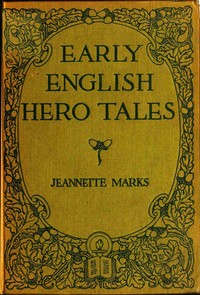
Early English Hero Tales — Themes and Context

(1 User reviews)   299
In Category - Folklore
Marks, Jeannette Augustus, 1875-1964 Project Gutenberg 2016
Heroes; Folklore -- Great Britain Readers of public-domain and historical texts
Project Gutenberg digital edition en

Edition facts

Words 26,242
Reading time 115 min
Text sections 4

Before opening Early English Hero Tales — Themes and Context, the edition data offers a quick orientation: 26,242 words, 1 hr 55 min estimated reading time, and 4 detected text sections.

The text analysis averages about 19.1 words per sentence, while the detected sections provide another way to judge how the source is divided.

Project Gutenberg metadata also associates the work with “Heroes,” connecting these edition facts with the source record’s subject description.

Jeannette Marks retells early English hero tales from Beowulf to Havelok the Dane, framing them as doors into a palace of literature. The introduction and chapter openings emphasize the multicultural origins of English storytelling, including Welsh, Danish, and Norman influences.
Share
Editorial Edition Score 4.6/5

Calculated from edition completeness, EPUB availability, text structure and catalogue metadata. Not a user rating.

How this score is calculated
  • Description quality20 pts
  • Title & short description10 pts
  • Source metadata20 pts
  • Text length15 pts
  • Chapters / structure15 pts
  • EPUB file integrity20 pts

Total of 100 points, scaled to a 2.5-5.0 range. Editions with an empty description or a missing EPUB file are not scored.

Edition quality

Read the Text

There was much going on that day in Heorot. Flocks of children were playing about the pretty paths. Mothers and aunts and older sisters sat spinning in the open doorways. Beyond the wide meadow young men and boys were leading or riding spirited horses up and down to exercise them.

And all--men, women, and children alike--were talking about Beowulf, who had come to kill the monster Grendel and free the people of Heorot.

Beowulf had not much more than entered the Hall when the scôp, or singer, as little Widsith's master was called, entered too. In those days singers were welcome everywhere. They saw Beowulf stride mightily across the many-colored floor of Heorot and go up to the old King. And they heard his voice, which sounded like the rumble of a heavy sea on their rock-bound coast.

"Hrothgar!" he said to the old King, "across the sea's way have I come to help thee."

"Of thee, Beowulf, have we need," replied the old King in tears, "for Heorot has suffered much from the monster."

"I will deliver thee, Hrothgar," said Beowulf, in his great voice; "thee and all who dwell in Heorot."

"Steep and stony are the sea cliffs, joyless our woods and wolf-haunted, robbed is our Heorot, for to Grendel can no man do aught. He breaks the bones of my people. And those of my people he cannot eat in Heorot he drags away on to the moor and devours alive."

And the old, bald-headed King, seated on his high seat in the Hall between his pretty daughter and his tired Queen, sighed as he thought of the approaching night. Yet, now that Beowulf had come, he hoped.

Together they gathered about the banquet. Beowulf sat among the sons of the old King. The walls inside were as bright as the roof, and gold-gilded, and the great fires from which smoke poured out through openings in the roof were cheerful and warm.

Then little Widsith's master was called up, and Widsith placed the harp for him. Clear rose the song from the scôp's lips, and all the company was still. For a while they forgot the monster which, even now with the falling dusk, was striding up from the sea, perhaps by the same path Beowulf and Widsith and the scôp had come. Already it had grown dark under heaven and darker in the Hall, and the place was filled with shadowy shapes.

And now came Grendel stalking from the cloudy cliffs toward the Gold Hall. It would have been hard for four men to have carried his huge head, so big it was. The nails of his hands were like iron, and large as the monstrous claws of a wild beast. And, since there was a spell upon him, no sword or spear could harm him.

While others slept--even frightened little Widsith, who had thought he could never sleep--Beowulf lay awake, ready with his naked hands to fight Grendel.

Suddenly the monster smote the door of Heorot, and it cracked asunder. In he strode, flame in his eyes, and before Beowulf could spring upon him or any one awake, he snatched a sleeping warrior and tore him to pieces.

Beowulf, who had the strength of thirty men in his body, gripped him, and the dreadful battle and noise began. The benches were overturned, the walls cracked, the fires were scattered, and dust rose in clouds from the many-colored floor as Beowulf wrestled with Grendel.

The scôp had seized his harp and was playing a great battle song, but music has no power over such evil as Grendel's. Beowulf himself, who was struggling to break the bone-house of the monster in the din of the mighty battle, did not hear it, either. And the song was lost in the noise and dust which rose together in Heorot.

Even the warriors, who struck Grendel with their swords, could not help Beowulf, for neither sword nor spear could injure the monster. Only the might of the hero, himself, could do aught.

At last, with the strength of thirty men, Beowulf gripped the monster. And Grendel, with rent sinews and bleeding body, fled away to the ocean cave where he had lived. And there in the cave, with the sea blood-stained and boiling above him, he died, outlawed for evil.

In the second part of this poem Beowulf was living as king in his own land, and ruling like the great and brave king he was. But a huge old dragon who was guarding a treasure was robbed. So angry was the dragon that he left his heap of treasure and came down upon the land of King Beowulf, burning it and terrifying the people. Then Beowulf, who had become an old man, felt that he must fight to save his people. He went out and slew the dragon, but was himself scorched to death by the fiery breath of the dragon.

"Beowulf" is the epic of our old English period. An epic is an heroic poem. In "Beowulf" the story of Beowulf's great deeds--such as his struggle with Grendel and Grendel's mother--and of his death is told. Probably it was sung before the fifth century, when the English conquered Britain, for England itself is not mentioned in this wonderful poem. Indeed, the country described is that of the Goths of Sweden and of the Danes. Your geography will show you where Sweden and Denmark are. When the English forefathers came to England they brought this poem with them, perhaps in the form of short poems which were woven together by a Christian Northumbrian poet in the eighth century or thereabouts.

It will be interesting to see how this wild moorland, over which Grendel stalked and over which the dreadful dragon dragged his length, became, with the cultivation of the land and advancing civilization, the gentle and beautiful dwelling of the fairies. The fairies will not live where it is too wild.

Much is to be learned from this epic of the customs and the manners of the men who came to Britain and conquered it. We can see these people as they lived in their sea-circled settlements, the ships they used to sail upon the sea, how their villages looked, and the boys and girls and grown-ups in them; the rocks and hills and ocean waves that made up their out-of-door world; the good times they had; their games and amusements. We come to know the respect that was given to their women; we see the bravery of the men in facing death, and we hear the songs they sang.

"Beowulf" is a great poem--English literature knows no poem that is more sacred to it--but it is a sorrowful poem, too. These people believed in Fate, for Christ had not yet been brought to them with His message of love and peace and joy. English poetry to-day is much more joyous--because it is Christian poetry--than it ever could have been if England had remained a heathen land. Yet English poetry still has much in common with "Beowulf," in love of the sea and worship of nature, and a strange sense of Fate.

But we must close this door over which is written _Beowulf_, for the Great Palace is full of many doors and many stories, and we have only just begun our journey from golden door to golden door.

On the other side of most of the golden doors through which we shall pass, our own tongue, English, is spoken. Yet in this wonderful palace, full of beautiful thoughts and beautiful expression, there are two doors which when thrown open we may enter, but where our English would not be understood. They both admit us to the poems and prose of families of the same race--a race called Celtic. Over one door of this family, however, is written _Cymric_, and all that is Cymric is written and spoken in Welsh. On the other door is _Gaelic_, and all that is Gaelic is Irish and Scotch. And the Great Palace of English Literature, with its innumerable golden doors, would not be at all the same palace if it were not for these two little doors, for out of them has come much that is best in poetry and prose.

The Welsh were already in Britain when the so-called "English" landed on the island, and these English, after one hundred and fifty years, succeeded in driving the Welsh, or Cymru, back to the mountains and coast on the west of the island. There they lived among the mountains, holding fast to their customs and to their songs and poetry. And by and by, when it was time for this miracle to happen, the little golden door over which was written _Cymric_, or _Welsh_, opened, and out of it there passed one of the most beautiful story-cycles the world has ever known, the tales about King Arthur. But of this great story we shall hear later.

This little golden door may be the oldest in all the palace, for long before the Arthur story was born there were other tales which the Cymru loved. There is a word "prehistoric" which accurately describes some of these stories known as _Mabinogion_, which means, literally, Tales for the Children, or Little Ones. This famous book was translated from Welsh into English by Lady Charlotte Guest in 1838. Among the oldest of these tales is "Taliesin," which has behind it a prehistoric singer, a mythic singer.

And now let us open that door over which is written _Cymric_, or _Welsh_, and look in.

Long ago, at the beginning of King Arthur's time and the famous Round Table, there lived a man whose name was Tegid Voel. His wife was called Caridwen. And there was born to them a son, Avagddu, who was the ugliest boy in all the world.

When Caridwen looked at Avagddu, and knew beyond any doubt that he was the ugliest boy in all the world, she was much troubled. Therefore she decided to boil a caldron of Inspiration and Science for her son, so that Avagddu might hold an honorable position because of his knowledge.

Caridwen filled the caldron and began to boil it, and all knew that it must not cease boiling for one year and a day--that is, until three drops of Inspiration had been distilled from it. Gwion Bach she put to stirring the caldron, and Morda, a blind man, was to keep the caldron boiling day and night for the whole year. And every day Caridwen gathered charm-bearing herbs and put them in to boil.

And it was one day toward the close of the year that three drops of the liquid in the caldron flew out upon the finger of Gwion Bach, who was stirring the liquid. It burnt him, and he put his finger in his mouth. Because of the magic of those drops he knew all that was going to happen. And he was afraid of the wiles of Caridwen, and in fear he ran away.

All the liquor in the caldron, except the three charm-bearing drops that had fallen upon the finger of Gwion Bach, was poisonous, and therefore the caldron burst. When Caridwen saw the work of her whole year lost, she was angry and seized a stick of wood. With the stick she struck Morda on the head.

"Thou hast disfigured me wrongfully," he said, "for I am innocent."

"Thou speakest truth," she replied; "it was Gwion Bach robbed me."

And Caridwen went forth after Gwion Bach, running.

When little Gwion saw her coming, because of the magic drops that had touched his finger, he was able to change himself into a hare. But thereupon Caridwen changed herself into a greyhound, and there was a race fleeter almost than the wind. Caridwen was nearly upon him when little Gwion turned toward the river and became a fish. Then Caridwen changed herself from a greyhound into an otter, and chased little Gwion under the water. So close was the chase that he had to turn himself into a bird of the air. Whereupon Caridwen became a hawk and followed him and gave him no rest in the sky. She was just swooping down upon him, and little Gwion thought that the hour of his death had come, when he saw a heap of winnowed wheat on the floor of the barn, and he dropped into the wheat and turned himself into one of the grains. And then what do you think happened? Caridwen changed herself into a high-crested black hen, hopped into the wheat, scratching it with her feet, found poor little Gwion Bach, who had once been a boy, then in turn became a rabbit, a fish, a bird of the air, and was now a grain of wheat.

Caridwen swallowed him! But so powerful was the magic of those three drops of Inspiration which had touched his finger, that little Gwion appeared in the world again, entering it as a beautiful child. And even Caridwen, because of his beauty, could not bear to kill him, so she wrapped him in a leathern bag and cast him into the sea. That was on the twenty-ninth day of April.

Where Caridwen threw little Gwion into the sea was near the fishing-weir of Gwyddno by Aberstwyth. And even as Caridwen had the ugliest son in all the world, so had Gwyddno the most unlucky, and his name was Elphin. This year Gwyddno had told Elphin that he might have the drawing of the weir on May Eve. Usually the fish they drew from the weir were worth about one hundred pounds in good English silver. His father thought that if luck were ever going to come to Elphin, it would come with the drawing of the weir on May Eve.

But on the next day, when Elphin went to look, there was nothing in the weir except a leathern bag hanging on a pole.

One of the men by the weir said to Elphin: "Now hast thou destroyed the virtue of the weir. There is nothing in it but this worthless bag."

"How now," said Elphin, "there may be in this bag the value of an hundred pounds."

They took the bag down from the pole, and Elphin opened it, and as he opened it he saw the forehead of a beautiful boy.

"Behold a radiant brow!" cried Elphin. "Taliesin shall he be called."

Although Elphin lamented his bad luck at the weir, yet he carried the child home gently on his ambling horse. Suddenly the little boy began to sing a song in which he told Elphin that the day would come when he would be of more service to him than the value of three hundred salmon.

And this song of comfort was the first poem the little, radiant-browed Taliesin ever sang. But when Gwyddno, the father of Elphin, asked him what he was, he sang again and told the story of how he had fled in many shapes from Caridwen; as a frog, as a crow, as a chain, as a rose entangled in a thicket, as a wolf cub, as a thrush, as a fox, as a martin, as a squirrel, as a stag's antler, as iron in glowing fire, as a spear-head from the hand of one who fights, as a fierce bull, as a bristly boar, and in many other forms, only to be gobbled up in the end as a grain of wheat by a black hen.

"What is this?" said Gwyddno to his son Elphin.

"It is a bard--a poet," the son answered.

"Alas! what will he profit thee?"

"I shall profit Elphin more than the weir has ever profited thee," answered Taliesin.

And the little, radiant-browed boy began to sing another song:

"Wherefore should a stone be hard; Why should a thorn be sharp-pointed; Who is hard like flint; Who is salt like brine; Who is sweet like honey; Who rides in the gale?"

Then bade he Elphin wager the King that he had a horse better and swifter than any of the King's horses. Thus Elphin did, and the King set the day and the time for the race at the place called the Marsh of Rhiannedd. And thither every one followed the King, who took with him four-and-twenty of his swiftest horses.

The course was marked and the horses were placed for running. Then in came Taliesin with four-and-twenty twigs of holly, which he had burned black, and he put them in the belt of the youth who was to ride Elphin's horse. He told this youth to let all the King's horses get ahead of him; but as he overtook one horse after the other he was to take one of the burnt twigs of holly and strike the horse over the crupper, then let the twig fall. This the youth who rode Elphin's horse was to do to each of the King's horses as he overtook it, and he was to watch where his own horse should stumble, and throw down his cap on that spot.

Thereupon the youth who rode Elphin's horse, and all the King's riders, pricked forth upon their steeds, their horses with bridles of linked gold on their heads, and gold saddles upon their backs. And the racing horses with their shell-formed hoofs cast up sods, so swiftly did they run, like swallows in the air. Blades of grass bent not beneath the fleet, light hoofs of the coursers.

Elphin's horse won the race. Taliesin brought Elphin, when the race was over, to the place where the horse had stumbled and where the youth had thrown down his cap as he had been told. Elphin did as Taliesin bade him and put workmen to dig a hole in this spot. And when they had dug the ground deep enough, there was found a large caldron full of gold.

Then said Taliesin: "Elphin, behold! See what I give thee for having taken me out of the weir and the leathern bag! Is this not worth more to thee than three hundred salmon?"

In the _Mabinogion_ stories, first collected and set down some time in the twelfth century, we live in a world of enchantment and fairies. Those tales are full of gold--the gold of a wondrous imagination. It would be nice if we could keep this door, over which is written _Welsh_, open long enough so that I might tell you the story of Pryderi, too, and how Pryderi found a castle where no castle had ever been, how he entered it and saw "In the center of the castle floor ... a fountain with marble-work around it, and on the margin of the fountain a golden bowl on a marble slab, and chains hanging from the air, to which he saw no end." What happened to him when he seized this cup, how the castle faded away, how the heroes of the story were changed to mice--for none of this can we hold open the golden door any longer. The ends of the golden chains of many a story are not to be seen by us.

THE BATTLE AT THE FORD

It is interesting to think, is it not, that if it had not been for those two little Celtic doors of gold over one of which was written _Cymric_, or _Welsh_, and over the other, _Gaelic_, or _Irish_, our Great Palace of English Literature could not have been the same palace, nor half so beautiful. It is not only that there would not have been so many wonderful golden doors leading into story-land, but the stories themselves would not have been told in the same way. The Scotch, too, who belong to the Celtic family, are almost as great story-tellers as the Welsh and Irish.

When the Roman Tacitus wrote about the Welsh and Irish he said, "Their language differs little." And even their buildings, Cæsar said, were "almost similar." What was true of their speech and their buildings was more true of the gifts they have left in the Great Palace. They have the same delightful way of telling a story; what they have to say naturally falls into conversations, and they are quick as a wink in the wit and fun and beauty and sadness of what they do say.

The introduction to Early English Hero Tales invites readers to imagine entering a Great Palace with more than a thousand golden doors, each opening onto rooms and gardens of extraordinary beauty. This metaphor, sustained throughout the book, frames the tales as luminous treasures that cast a glow over the world. Marks, a lecturer at Mt. Holyoke, selects stories from the seventh to the fourteenth century, beginning with Beowulf and including Welsh magic, Cædmon the cowherd, and Havelok the Dane. The catalog subjects—heroes and British folklore—are accurate, but the excerpts reveal a stronger emphasis on the multicultural roots of English literature, with explicit discussions of Welsh, Irish, Danish, and Norman contributions.

The Palace Metaphor and Its Limits

The opening metaphor of a palace with golden doors recurs in chapter titles like “At Geoffrey’s Window” and “Through Golden Doors,” but the excerpts do not show the metaphor being consistently applied to each tale. In the introduction, Marks compares the palace lamps to those in the Welsh story of Pryderi, noting that the chains’ ends are invisible. This specific reference ties the metaphor directly to one tale, yet the catalog subject “Folklore – Great Britain” is broad enough to encompass such Welsh material. The metaphor serves as a unifying device, but the excerpts suggest it is most fully developed in the introduction and less so in the individual chapters.

Multicultural Origins of English Storytelling

Marks explicitly states that English literature was built by Welsh, Irish, Scotch, Danes, and Normans, not English hands alone. She notes that the word “English” was brought by an invader, and that Danish stories like “Havelok the Dane” and “King Horn” were written down around 1280 but told earlier. The excerpts also mention Norman influence on Malory’s “Morte d’Arthur.” This emphasis on cultural blending is more pronounced than the catalog subjects suggest; the catalog lists only “Heroes” and “Folklore – Great Britain,” without indicating the book’s attention to the diverse ethnic origins of the tales. The excerpts show that Marks is as concerned with the history of the stories’ transmission as with the heroes themselves.

Alfred the Great as a Literary Figure

One chapter focuses on King Alfred, whom Marks calls the true “father of English prose.” She describes his efforts to translate Latin works into English, his establishment of a court school, and his comparison to a productive bee by his secretary Asser. The chapter emphasizes Alfred’s role in making education accessible to free-born youth, contrasting with the catalog’s generic “Heroes” subject. The excerpts show that Marks treats Alfred not as a warrior but as a scholar-king, highlighting his translations of Bede’s History and Pope Gregory’s Pastoral Care. This portrayal aligns with the book’s broader theme of literature as a civilizing force, but the catalog does not capture this specific focus on Alfred’s literary contributions.

Readers approaching Early English Hero Tales should expect a work that blends storytelling with literary history, often pausing to explain the origins of the tales. The book’s structure—introduction, ten chapters, and a chronology—suggests a pedagogical aim, likely for young readers. The excerpts reveal that Marks prioritizes the cultural context of each hero over dramatic action, making the volume more an introduction to early English literature than a collection of pure folklore.

The rain kept rhythm with Early English Hero Tales, and I lingered on Marks’s quiet insistence that every story carries another culture’s footprint. That same feeling surfaced later, unexpectedly, while turning through the grassland voices in Blackfeet Tales of Glacier National Park — Text and Context. Different landscapes, sure, but the same hum of belonging beneath the words.

Harper Davis
1 week ago

4
4 out of 5 (1 User reviews )

Add a Review

Your Rating *
There are no comments for this eBook.

Reader reflection

How did this book work for you?

Your answers remain private and are stored only in this browser.

Your progress 0 / 10
1

What is your current status with this title?

2

Was reading this book enjoyable?

3

Is this a title you would suggest to others?

4

What was the reading difficulty like?

Related eBooks