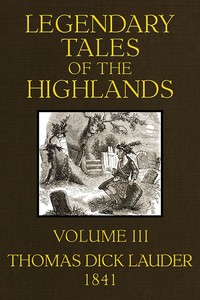
Legendary Tales of the Highlands (Volume 3 of 3) A sequel to Highland Rambles — Reading Notes

(0 User reviews)   18
In Category - Folklore
Lauder, Thomas Dick, Sir, 1784-1848 Project Gutenberg 2019
Legends -- Scotland; Highlands (Scotland) -- Fiction Readers of public-domain and historical texts
Project Gutenberg digital edition en

Edition facts

Words 63,980
Reading time 279 min
Text sections 12

Before opening Legendary Tales of the Highlands (Volume 3 of 3) A sequel to Highland Rambles — Reading Notes, the edition data offers a quick orientation: 63,980 words, 4 hr 39 min estimated reading time, and 12 detected text sections.

The text analysis averages about 23.2 words per sentence, while the detected sections provide another way to judge how the source is divided.

Project Gutenberg metadata also associates the work with “Legends -- Scotland,” connecting these edition facts with the source record’s subject description.

Sir Thomas Dick Lauder's third volume of Highland folklore blends dark humour with supernatural terror, as seen in the Nairnshire farmer's onstead described with comic precision and the ghostly warning scene where moonlight transforms a rescuer into a spectre.
Share
Editorial Edition Score 4.8/5

Calculated from edition completeness, EPUB availability, text structure and catalogue metadata. Not a user rating.

How this score is calculated
  • Description quality20 pts
  • Title & short description10 pts
  • Source metadata20 pts
  • Text length15 pts
  • Chapters / structure15 pts
  • EPUB file integrity20 pts

Total of 100 points, scaled to a 2.5-5.0 range. Editions with an empty description or a missing EPUB file are not scored.

Edition quality

Read the Text

Pensassenach had fled, they began to wreak their rage, and to glut their rapacity, by plundering her effects. Meal, butter, cheese, beef, and bacon, were crammed indiscriminately into sacks, with articles of wearing apparel, and the blankets, and the webs of cloth and linen which the thrifty housewife had prepared for her household. Articles of silver plate were not forgotten, as well as all other valuables upon which they could lay their rapacious hands. The cellar was broken open and ransacked, and its contents, as well as many other pieces of plunder of a bulky nature, were stowed away to be carried off in the carts belonging to the farm. A general assault then commenced upon the live-stock. John Smith's zealous precaution had secured the greater part of the larger animals from their clutches, but the attack on the poultry was simultaneous and terrific. Loud was the cackling, gobbling, and quacking of the fowls, turkeys, ducks, and geese, as they were caught, one after another; and fearful was it to hear their music suddenly silenced, by their necks being drawn, and melancholy to behold their exanimate bodies thrown into the hampers that hung on the crook-saddled horses. The good Morag's heart was rent, as she beheld these ruthless murders committed upon the innocent creatures whom she had delighted to rear. But honest John Smith comforted himself with the reflection, that he had saved all the weightier and more valuable stock, and therefore he witnessed all these ravages among the feathered folk with tolerable composure, until a circumstance occurred which renewed all his apprehensions for the safety of his mistress, and again excited him to the full exertion of all his energies.

War had not been long commenced against the poultry, when the large sow, alarmed by the murders she beheld going on around her, and terrified by the loud hurrahs of the plunderers, as well as scared by the sudden striking up of the bagpipes, took to flight in good time, and made straight for the eye of the killogie, at the head of her troop. The quick-sighted John Smith at once perceived the risk which his mistress, the Pensassenach, ran, of being discovered, by the animals making this attempt to find shelter there. Off he flew like the wind to intercept them; and cutting in before them with great adroitness, he turned them right away towards the fragment of meadow, which lay in the close vicinity of the black bog. John played his part so well, that this manoeuvre of his had all the appearance as if he had been merely making a dash at them for the purpose of catching some of them, and that the creatures had for the present foiled him. There they were accordingly left at peace for a time, during which John's mind also remained in some degree tranquil and at ease.

But the sow and her inviting family were not long in being descried by the Highlanders, after every other living thing had been sacked by them, and a most eventful, hazardous, and very ludicrous chase after them immediately took place. Full of the most anxious apprehensions as to the result, John planted himself in front of the killogie, and between it and the scene of action; and as all the old sow's efforts were directed towards her stronghold in the kiln, it was with the greatest difficulty that he repeatedly succeeded in driving her from the dangerous post. At length, by one exertion, greater than the rest, he had the good fortune to force the sow once more fairly a-field again, with all her grunting young ones running scattering after her, whilst the Highlanders, deceived by his shouting to them in Gaelic, and encouraging them to the pursuit, believed that he had no other object in view than honestly to aid them in catching her. To blind them still more, he now started off full tilt at the head of them, and soon outran the swiftest of them. With amazing dexterity, he first clutched up one pig, and then another, until he had one in each hand, swinging by the tail, and squeaking so fearfully, as to excite the maternal anxiety and rage of the sow mother, to so great an extent, that she followed him, fast and furiously grunting, wheresoever he turned. John inwardly chuckled at the thought of having thus got so easily and so perfectly the command of her motions. But a sudden onset from the Highlanders speedily dispersed the remainder of her progeny; and the pursuers naturally scattered themselves to follow after individual grunters, so that the race was seen to rage over all parts of the field. This distracted the attention of the old sow, and she went cantering about, hither and thither, like a frantic creature, until, by degrees, she found herself at the very farthest end of the bog. There, seized by a panic, she suddenly turned, and bolted desperately back again, with her snout pointed directly towards the kiln. Winged by terror, she pushed wildly on at a bickering pace, and running her head right between John's legs, ere ever he wist, she carried him off for several yards, horsed upon her back, with his face to the tail; and in the blindness of her alarm, she ran headlong with him into a great peat-pot, where he was instantly launched all his length among the black chaotic fluid which it contained. John scrambled out of the hole with some difficulty, and, starting to his legs, and shaking his ears like a water-spaniel, and clearing the dirt from his eyes, he, to his great horror, beheld the sow scouring away as hard as she could gallop, in a direct course for that chamber in the killogie, which prescriptive right had so long made her believe to be her own. John saw her hurrying thither, pursued by one or two of the Highlanders. It was evident that she must soon reach it; and he felt certain that she would instantly dart in among the straw where the Pensassenach was lying, and that so the lady must be exposed to certain discovery, and consequently to instant death. What was to be done? Not a moment was to be lost. Taking advantage of a double which the sow was compelled to make, in consequence of some one having headed her course, and which forced her to swerve considerably from the straight line of the chase, John seized a gun from the hand of a Highlander near him, and aiming at the animal as she thus presented her great broadside to him, he fired at her, and rolled her over and over, by a bullet that passed through her very heart. There she lay dead before her pursuers, within some thirty or forty yards of her perilous place of refuge. A shout of applause at so wonderful a shot arose from all who witnessed it.

"Tat's ta learn her, mockel fusome beast tat she is, for tummelin Shon Smiss inta ta peat-hole!" cried John, infinitely relieved from all his terrors.

The pigs were now very speedily secured in detail, and the great sow was dragged up to the farm-house, and quietly deposited, with her slaughtered family, in one of the carts.

"My brave fellow!" said Captain M'Taggart, the leader of the party, now advancing towards John, and shaking him heartily by the hand, "you must come along with us. A young man, so handsome, so active, so spirited, and so soldierly-looking,--and, above all, so capital a shot as you are,--was never intended by nature to hold the stilts of a plough, or to fill dung-carts. You were born to be an officer at the very least, and, for aught I know, to be a colonel or a general. We are already aware that you are stanch to the righteous cause of the true Prince. Now is the time for you to raise yourself in the world, by joining his royal standard. Come, then, and lend us your powerful aid in placing our lawful King upon the throne of his ancestors!--Come along with us, and I shall forthwith introduce you to Prince Charles, who may yet make a lord of you before you die."

John Smith was, in truth, all that M'Taggart had called him, being a handsome, good looking man, as brave as a lion, and not altogether devoid of a certain natural ambition. But he was ignorant, thoughtless, and credulous, owing to his having been, up to that day, entirely without experience. He had never before seen anything like military array, and irregular and deficient, in many respects, as that was which he now beheld, still it was enough to captivate his unpractised eye. John had a strong attachment to his master and mistress, who had always been very kind to him. But his devotion to the Prince, whom he had never seen, was of a higher and holier order. Bestowing a few moments of reflection on the ceaseless and profitless plodding, and slavish drudgery of his present duties, all, in themselves, absolutely repugnant to the very nature of a Highlander, and comparing them with the ideal picture he had drawn to himself, of the gallant, gentlemanlike service of the Prince, whose soldiers, he believed, had not only daily opportunities of enriching themselves with honourable plunder,--a small specimen of which he had just witnessed--but who had the prospect opened to them of one day becoming great men, the contrast was by far too flattering in favour of the latter not to dazzle him. But if it had not had that effect, the promise which M'Taggart made him of introducing him to Prince Charles, the son of the true and legitimate King of Scotland, was enough of itself to have gained John's consent in a moment.

"Ou, troth, she'll no be lang o' gangin' wi' her," said John, "an she'll but stop till she clean hersel' a wee frae ta durt o' ta fulthy bog, tat ta soo beast pat her intill,--and syne bids fereweel to ta leddy."

"Whoo!" exclaimed M'Taggart.--"The lady! What, then, the Pensassenach is somewhere about the place after all, and you know where she is?--By holy St. Mary, but I will burn every house here, and force the rancorous whig she-devil to unkennel out of her hiding place!"

"Teel purn her nane sell's fooliss tongue for namin' ta leddy ava ava!" said John bitterly. "But she may e'en purn ta hale toon gin she likes--fint a bit o' ta leddy can she purn."

"Ha, my good fellow," said M'Taggart, "since you have the secret knowledge of her place of concealment locked up in your bosom, what is to hinder me to use a thumbikin as a key to unlock it.--I have a great mind to try."

"She may e'en puts ta toomkin on her nanesell's neck, and she'll no tell after a'," said John resolutely. "And ponny pounties tat wad be surely for Shon Smiss to serve ta Prince."

"Nay, my good fellow, I was only joking," said M'Taggart, afraid to lose so good a volunteer; "trust me I meant you no harm."

"Gin she purns ta toon, or gin she do ony mair ill aboot ta place, fouk wull be sayin' tat Shon Smiss bid her do it," continued John--"an tat wad be doin' Shon mockell harm. Teevil ae stap wull Shon be gangin' wi' her at a' at a', an she do ony mair bad sings here."

"Well well," said M'Taggart, soothing him, "go in and dress yourself, and make your mind easy; and the sooner we are away from here the better."

John thought so too. He ran to the stable for his breachcan; [2] put on his best coat, kilt, and hose; tied up his only two shirts, and a spare pair of hose, in a napkin, and placed the bundle into the fold of his plaid; and then seizing a trusty old broad-sword, he put on his new Sunday's bonnet, smartly cocked up,--and he strode so erectly forth to M'Taggart, and with so martial an air, that, added to the wonderful change created in his personal appearance by his dress, made the captain hesitate for a moment in believing him to be the same man.

"She be ready noo," said John; "put fare be ta rest o' ta men, Captain!"

"They are hunting the Pensassenach," replied M'Taggart with a careless laugh.

"She pe verra idle loons tan," said John, "for gin she wad seek a' tay she wad na' find her." And then, by way of diverting the Captain's attention from the search by a joke, he pointed to Morag, who stood at the door, weeping bitterly at the prospect of his departure, and added,--"see, tat pe ta Pensassenach."

"That the Pensassenach!" said M'Taggart.--"That's a good joke truly. I know well enough that's not the Pensassenach that we are after."

"She pe a verra ponny Pensassenach," said John, going up to Morag, and hastily delivering to her, in a Gaelic whisper, directions how and when she should relieve her mistress from her confinement, and also where she was to look for the packman, that she might get him taken out of the water.

"That Pensassenach seems to be a favourite of yours, John," said the Captain.

"She wunna say put she is," replied John, his heart filling a little with sympathy for Morag's tears, and at the prospect of leaving her.--"Petter tak tiss Pensassenach wi' huss,"--and then, rather as a parting word of kindness than anything else, he added, "will she go, Morag?"

This was too much for poor Morag. Her heart was too full for her to command words to reply. She rushed forward, and threw her arms around John. She fixed her hands into the folds of that breachcan, in which, in their days of herding, when she was but a lassie, and he but a boy, she had been so often wrapped by her lover as a shelter from the stormy elements, and she gave way to a burst of grief that at length enabled her to find utterance for her feelings. She implored him, in all the anguish of despair, not to leave her. John's heart was softened by her words, and her tears, and he blubbered like a child. M'Taggart, fearing that the martial influence in John's soul might be overpowered and extinguished by that of love, and setting a much greater value on him as a recruit, than on the capture of the Pensassenach, he thought it advisable to put an end to this tender interview as speedily as might be. He ordered the piper to play up therefore, and the men, abandoning their fruitless search after the English wife, were speedily gathered around him. The train of carts and horses, with the plunder, were driven on--the order of march was formed. John, after a severe struggle with his heart, rent himself away from the arms of Morag, and followed M'Taggart, without daring to speak, or to look behind him; whilst the poor girl, bereft of her support, fell upon the green--where she lay beating her breast and tearing her hair in utter despair, till the sound of the distant pipe died away, and the presence of some of her fellow-servants brought her back to her reason.

Morag was no sooner sufficiently calm and collected, than she hastened to execute John Smith's last injunctions. The poor Pensassenach was taken from the killogie more dead than alive. Morag would have had her to go to bed, but, having recovered herself a little, she became too much excited to rest; and, having arranged her dress, she began to bustle about her affairs, and to take a full note of her loss. It was, indeed, severe. But she felt that she endured it for a glorious cause, and that reflection made her bear it with wonderful philosophy. She was grieved, and even angry to learn that John Smith had enlisted with the Prince's men, but she felt deeply grateful to him for having saved her life; and especially so, when she heard from Morag the story of the packman's treachery, and John's ingenuity in defeating it, as well as of the whole of his exertions for her preservation.

"Where has John bestowed the villain?" demanded the Pensassenach.

"Toon in ta lint pot, memm," replied Morag; "I maun gang toon an get him oot o' ta holl noo."

"I'll go with you, Morag," said the Pensassenach; and so mistress and maid proceeded together towards the pond. "What noise is that?" cried the Pensassenach, as they drew near to it.

"Aw--yaw!--yaw--aw!" cried the packman from the pool.

"Where are you, wretched man?" cried the Pensassenach.

"Yaw--aw!--yaw--aw!" replied Mr. Dallas.

"Why don't you speak distinctly?" demanded the lady.

"Aw--aw!--yaw--aw!" replied Dallas again.

"The sound would seem to come from under that loose heap of rushes at the margin of the pool yonder," said the Pensassenach.

"Oich aye, she's here memm," cried Morag, removing the covering from the packman's head.

"Ya--aw!--aw--aw!" cried Dallas, raising his eyes with an expression of intense agony.

"Ah, I see how it is," said the Pensassenach; "John has gagged him, to prevent his vile tongue from betraying me. Loosen that string, Morag, and take out the gag."

"Oh, Heeven be praised that I hae fand freends at last," cried the packman in a hoarse voice. "Hech, my jaws are stiff, stiff, and sair, sair, wi' that plaguit bit o' a rung that John Smith pat into my mooth. Hech me! kind souls that ye are, pu' me oot, pu' me oot o' this, or I maun e'en drap awthegither owerhead into the pool, for I haena mair poor to stand on this ae leg o' mine, and I canna rest ony at a' on the short ane, mind ye, without sinkin' my mooth below the water. Och, memm, pu' me out!"

"How can you ask me to assist you, base wretch that you are?" cried the Pensassenach; "you who would have sold my life to have saved your own. I shall push you as gently under the water as I can, but drowned you must be."

"Oh, for the love o' Heeven hae mair charity!" cried the packman most piteously. "I'm a sad sinner, nae doot. But I'm a puir, wake, nervish craytur,--and fan that deevil incarnate, Captain M'Taggart, spak o' hangin' me, my brains whurled sae i' my head, that I didna ken what I was sayin'. But I'm sure I never thocht o' doin' harm till you or ony o' your hoose. Pu' me oot, memm; pu' me oot for the love o' Heeven, or the very life'll leave my legs wi' cauld."

"Pull you out," exclaimed the Pensassenach; "pull you out,--you who would have helped the Highlanders to my murder: pull you out, who wilfully spoke treason, to aid, abet, and comfort the rebel Captain. My loyalty to my King and my country forbids me to assist you, and compels me to make a sacrifice of you immediately. So, prepare for instant death."

"Och, hae mercy on my puir sowl," cried the packman in despair; "surely, surely, ye're no gawin' till droon me?"

"What can you say in exculpation of your treason?" demanded the Pensassenach, laying hold of the upper part of the sack with both her hands, and giving Mr. Dallas a gentle shake.

"Och, naething--naething ava," cried Mr. Dallas. "Oh, I'm a dead man--a dead man: hae mercy--hae mercy upon me. I'm a great sinner--a wicked, and hardened sinner."

"Perhaps it were well to allow you a few moments, wretch that you are, to confess your sins and repent, before you are sent into the other world," said the Pensassenach. "So make haste--lose not the fleeting space of time which I thus mercifully grant to you, and lighten your soul of as much load as you can."

"Oh, hae mercy--hae mercy on me!" cried Dallas.

"I'll have no mercy on you, more than this," cried the Pensassenach, in a terrible voice. "If you will not confess yourself, your last moment is at hand;" and so saying, she ducked Mr. Dallas's head under the water.

"O! O! O! Oh!--hech! ech!" cried Mr. Dallas, panting for breath; "I'm a dead man! I'm a dead man! Oh, Lord forgie me for sellin' pastes for precious stanes."

"Come! is that all?" cried the Pensassenach, shaking him again.

"Hae mercy on me for sellin' rock crystal for diamunts," cried Dallas.

"Come! out with it all!" said the Pensassenach.

"Oh! Och! Forgie me for sellin' bits o' ayster shells for pearls," cried Dallas again, "and pinchbeck for gold; and watches wi' worn out auld warks for new anes."

"Come! nothing else to confess?" said the Pensassenach.

The third volume of Sir Thomas Dick Lauder's Legendary Tales of the Highlands opens with a Nairnshire farmstead described in painstaking, almost architectural detail: a two-story house with crow-stepped gables, grey slate, and outbuildings arranged at right angles, their smoke issuing from both chimneys and low doorways. This precise setting grounds the supernatural events that follow, creating a tension between the mundane and the uncanny.

In one excerpt, the narrator's aside on the word 'midden'—speculating it may derive from 'middle-in' because the midden sits at the centre of every Scottish farm—reveals Lauder's habit of blending folk etymology with wry observation. Such digressions give the tales a conversational, almost rambling quality, as if the storyteller is as interested in the texture of rural life as in the legends themselves.

Comic Precision and Supernatural Terror

Lauder's narrative voice shifts abruptly from the matter-of-fact to the eerie. The farmstead is described with the eye of a surveyor: the house 'mathematically' faces the twelve o'clock line, corn ricks bulge like 'drunken Dutch dancers', and the midden is a hazard for unwary visitors. This comic precision makes the later supernatural encounter all the more jarring.

When Morag warns the wounded man, the moonlight illuminates her face at the window—but John Smith, roused from sleep, sees only a 'pale, bloody, and death-like' apparition. The same features that are familiar to Morag become, under the moonlight, those of a ghost. Lauder exploits this visual ambiguity: the rescuer becomes a spectre, and the warning is mistaken for a supernatural visitation. The scene hinges on a single beam of light and a shared cultural belief in ghosts.

Dialogue as a Marker of Loyalty and Betrayal

The dialogue in the excerpt reveals a household divided. Ian and Hamish, the old couple's sons, speak with a threatening edge: 'Sit down quietly in this chair... By the great oath you had better!' Their father accuses them of being tempted by the Devil, while the old woman cries out in Gaelic. The tension is not only between captors and captive but within the family itself.

Morag's decision to act—slipping out, moving 'quickly round the house', pushing open the window—is set against the sons' plan to bind the wounded man and hand him to the Duke of Cumberland. Lauder uses the contrast between the sons' rough commands and Morag's whispered Gaelic warning to underscore the moral stakes. The language itself becomes a marker of allegiance: the sons speak English-inflected threats, while Morag's warning is in Gaelic, the language of intimacy and survival.

The Wounded Man as a Figure of Suspended Agency

John Smith, the serjeant of the title, is introduced in a state of vulnerability: wounded, asleep, buried in straw, and invisible in the dark corner of the room. When Morag awakens him, his response is slow—'a quick rustling noise among the straw, and then she heard the slow heavy step'—and his appearance at the window is described as 'pale, bloody, and death-like'. He is less a hero than a figure of pathos, his agency suspended until the final moment when he kicks open the door and draws his claymore.

Lauder emphasises Smith's superstitious awe: the 'well known though hollow voice', the 'solemn warning', and the 'unaccountable appearance of Morag' convince him he has seen a ghost. Only the sound of steps and voices in the outer room recalls him to action. The narrative thus delays his agency, building suspense through his immobility and mistaken belief, before releasing it in a sudden, violent motion.

Readers approaching this volume should attend to Lauder's use of setting as both a realistic backdrop and a stage for the uncanny. The farmstead, with its precise geography and comic details, is not merely a picturesque scene but a space where the boundaries between the natural and supernatural blur. The moonlight, the midden, the thatched roofs—all are charged with potential. Lauder's digressions, far from being mere padding, often contain the key to his method: the folk etymology of 'midden' is as much a part of the legend as the ghostly warning itself.

I think of that third volume’s moonlit spectre—how rescue wore a ghost’s face—and I’m reminded of another old friend, Legends of the Patriarchs and Prophets And Other Old Testament Characters from Various Sources — Reading Companion. Both whisper that the strangest truths arrive half-disguised, waiting for patient lamplight. They share a shelf in my memory, quiet companions in the craft of holy awe.

There are no reviews for this eBook.

0
0 out of 5 (0 User reviews )

Add a Review

Your Rating *
There are no comments for this eBook.

Reader reflection

What did you think of this book?

Answer a few questions and save a private reflection on this device.

Your progress 0 / 10
1

Have you finished this book?

2

What was your overall reaction to the book?

3

Would you encourage someone else to read it?

4

What was the reading difficulty like?

Related eBooks