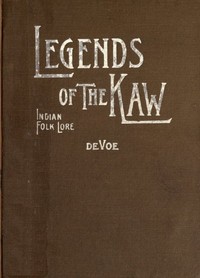
Legends of the Kaw — Reading Companion

(2 User reviews)   355
In Category - Folklore
De Voe, Carrie Project Gutenberg 2011
Indians of North America -- Folklore; Indians of North America -- Kansas Readers of public-domain and historical texts
Project Gutenberg digital edition en

Edition facts

Words 38,638
Reading time 168 min
Text sections 4

This digital edition of Legends of the Kaw — Reading Companion is described by source-level measurements including 38,638 words, 2 hr 48 min estimated reading time, and 4 detected text sections.

The text analysis averages about 18.8 words per sentence, while the detected sections provide another way to judge how the source is divided.

Project Gutenberg metadata also associates the work with “Indians of North America -- Folklore,” connecting these edition facts with the source record’s subject description.

Carrie De Voe's 1904 collection of Native American folklore from the Kansas River Valley, blending ethnographic description with dramatic narratives of tribal history, mythology, and encounters with settlers.
Share
Editorial Edition Score 4.6/5

Calculated from edition completeness, EPUB availability, text structure and catalogue metadata. Not a user rating.

How this score is calculated
  • Description quality20 pts
  • Title & short description10 pts
  • Source metadata20 pts
  • Text length15 pts
  • Chapters / structure15 pts
  • EPUB file integrity20 pts

Total of 100 points, scaled to a 2.5-5.0 range. Editions with an empty description or a missing EPUB file are not scored.

Edition quality

Read the Text

e was an idea, current among the Indians who roamed over the central portion of the United States, that at one time in the long past, the rivers of the Mississippi basin filled the entire valley, and only great elevations were visible. Geology substantiates this teaching. The theory of a dual soul approached very close to the teachings of modern psychologists. While one soul was supposed to remain in the body, its companion was free to depart on excursions during sleep. After the death of the material man, it went to the Indian elysium and might, if desirous, return, in time, to earth, to be born again.

Like that of all uncivilized races, the ancient religion of the North American Indian was incoherent. Association with Europeans produced changes. Doctrines before unknown to the red man were engrafted upon his faith. Some writers maintain that it is doubtful if the idea of a single divinity had been developed previous to intercourse with missionaries. Brinton asserts that the word used by the natives to indicate God, is analogous to none in any European tongue, conveying no sense of personal unity. It has been rendered Spirit, Demon, God, Devil, Mystery and Magic. The Dakota word is _Wakan_ (above), the Iroquois, _Oki_; the Algonquin, _Manito_. God and heaven were probably linked together before there was sufficient advancement to question whether heaven were material and God spiritual; whether the Deity were one or many. Good Spirit and Great Spirit are evidently of more recent origin and were, perhaps, first suggested by missionaries, the terms being applied to the white man's God, and adopted by the Indian and applied to his own. The number of spirits was practically unlimited, communication being usually in the hands of the medicine men, although the unseen world was often heard from directly in dreams.

A description of heaven--by Wampasha, an Iowa Indian--was found in the diary of Reverend S. M. Irvin, a devoted missionary among the Iowas and Sacs. It reads:

"The Big Village (heaven) is situated near the great water, toward the sunrise, and not far from the heads of the Mississippi River. None go there until after they die. A smart person can make the journey in three or four days; if, however, his heart be not right at death, the journey will be prolonged and attended with difficulties and stormy weather till he reaches the land of rest. Infants, dying, are carried by messengers sent for them; the old or infirm are borne upon horses; they have horses, plenty, and fine grass, and infirmities will all be healed in that village. The blind will receive new eyes; they have plenty of good eyes and ears there. Good people will never die again, but the bad may die three or four times and then turn into some bird."

Father Allouez, one of the first missionaries among the Algonquins, entered a village never before visited by a white man. He was invited to a council, and the old men, gathering around him, said:

"It is well, Blackrobe, that thou dost visit us; thou are a Manito; we give thee to smoke. The Iroquois are devouring us. Have mercy upon us. Hear us, O Manito! we give thee to smoke. Let the earth yield us corn; the rivers give us fish; sickness not slay us; nor hunger so torment us. Hear us, O Manito! we give thee to smoke."

Birds and beasts were selected as guardians. Everyone considered his _totem_ a protector, and refrained from killing it. Whole clans were believed to be descended from a common _totem_ and information was conveyed by means of omens.

The character of a nation is engraven upon its literature, which, like a mirror, reflects the thoughts, emotions and progress of a people. The folklore of the North American Indians was their literature. The myth, grounded upon the unchanging laws of the universe, was conscious, however vaguely, of great principles that are forever true. Physical existence formed the basis of each important fable. The earth, air, water and other elements were personified. Every image had its moral significance.

Mythology has been said to be simply the idea of God, expressed in symbol, figure and narrative. That of primitive America was founded upon the conviction that there was, in pre-historic times, another world inhabited by a people strong and peaceable. So long as harmony reigned, comfort and happiness were theirs, but when discord entered this Eden, conflict succeeded conflict, until, to punish his disobedient children, the Master of Life transformed them, one by one, into trees, plants, rocks and all the living creatures. It was said that each person became the outward embodiment of what he had previously been within himself. For instance, from the head of one sprang an owl, from another a buzzard, a third became an eagle, and in this manner was the present world with its three kingdoms, vegetable, animal and mineral, evolved.

Another tradition says that in the days of turmoil, a powerful man, or demi-god, ran to the place where the earth and sky meet, and with a lighted torch, set fire to the tall grass, igniting the earth itself. Those worthy of preservation were caught up to a place of safety. Sparks, rising from the flames, and finding lodgment high above, became the twinkling "sky-eyes," which, in the language of the white man, are called stars.

After the conflagration had subsided, one whose duty in the upper sphere had been to provide water, carried it in a basket; and as she walked, drop after drop fell through upon the parched region below, causing it to revive. Awakened Nature blossomed into new beauty, and all who had escaped the terrible fire fiend, returned to take possession of the country. The Water-Maiden still carries the basket; and its contents, which never grow less, still fall in gentle showers, to refresh the land.

Among the beautiful creation myths, is that of the Earth-Maiden, who, through being looked upon by the sun, became a mother, giving birth to a wonderful being, a great benefactor. By reason of his benign influence, mankind lives and prospers. This benefactor is really the warm, wavering light, to be seen between the virgin earth, his mother, and the sun.

There are numerous narratives in which heat, cold, light and darkness appear as leading actors. A powerful god of the Algonquins was the maker of the earth, Michabou (light), toward whom the Spirit of Waters was ever unfriendly.

In Mexico, the worship of the sun and other heavenly bodies was practiced, sacrifices of men and women with white faces and hair being particularly acceptable.

Almost all aboriginal people believed that dogs occupied a peculiar position with regard to the moon, possibly because of the canine habit of baying at that planet.

The bird and the serpent were especially honored. The former, no doubt, because of its power of floating through the air and the latter for its subtlety. The Hurons told the early Jesuits of a serpent with a horn capable of penetrating rocks, trees and hills--everything it encountered. The person fortunate enough to obtain a portion for his medicine bag was sure of good luck. The Hurons informed the missionaries that none of their own people had ever seen the monster; but the Algonquins occasionally sold them small portions of its horn for a very high consideration. The Shawnees, who had unquestionably practiced on the credulity of their neighbors, led roving lives and had become familiar with the myths of many nations. It is not unlikely that the serpent fable originated with the Creeks and Cherokees, who thought the immense snake dwelt in the waters. Tradition says that old people stood on the shores and sang sacred songs. The creature came to the surface, showing its horns. The magicians cut one off and continued to chant. The serpent again appeared, and the other horn was secured and borne away in triumph.

These tribes asserted that in the fastnesses of their mountains was the carefully guarded palace of the Prince of Rattlesnakes. On the royal head shone a marvelous jewel. Warriors and priests endeavored in vain to get possession of the glittering trophy. Finally, one more thoughtful than the rest encased himself in leather, passed through the writhing, hissing court, unharmed by poisoned fangs; tore the coveted charm from the head of the prince, and carried it home. The gem was ever preserved with great care and brought forth only on state occasions.

The story of Hiawatha (Hi-a-wat-ha), which Schoolcraft gives as an Iroquois legend, is found among the traditions of many tribes, the leading character being called by different names. In the East he was known as Glooskap, about the lakes as Manabozho, in other localities as Chiabo; but, as in certain Aryan myths--of which this may be one--the principal features of the story are the same in all nations. Their hero came to them as did Buddha to the East Indian, and Christ to those prepared to receive the gospel, bearing messages of peace, good will to men; teaching justice, patience, conformity to truth, and to the laws of the red man; instructing them in various manual arts, and destroying hideous monsters that lurked in the woods and hills, or lay concealed amid the tall prairie grass. He lived as a warrior, hunted, fished and battled for right, changing when necessary, to any animal or plant. While seated in his white stone canoe on one of the Great Lakes, he was swallowed by the King of Fishes. Undaunted, he beat its heart with a stone club until it was dead, and when birds of prey had eaten the flesh, and light shone through, climbed out with the magic boat.

The struggle with fire-serpents, in order to reach the wicked Pearl Feather, whom he fought the livelong day, has been recounted again and again. How a woodpecker flew overhead, screaming "Shoot at his scalp-lock!" How, obeying this admonition, Hiawatha saw the enemy fall in the throes of death, and dipping his finger in the blood, touched the bird, and to this day a red mark is found on the head of the woodpecker. He slew the Prince of Serpents, traveled from village to village performing good works, and having wedded a beautiful Dakota woman, presented a perfect example of faithfulness and devotion. A league of thirteen nations was formed through the influence of this remarkable man; and as he stood among the assembled chiefs, addressing them with supernatural eloquence, encouraging them in a voice of sweetness and power to lives of rectitude, the summons came. Promising to return at some future time, Hiawatha stepped into his white stone canoe and was lifted heavenward, the air trembling with soft music as he floated from sight. To this final pledge are attributable many ghost dances and outbreaks against the whites, notably that at Pine Ridge Agency, when the coming of the Messiah was expected with full confidence.

The well-known legend of the Red Swan was a satisfactory explanation of the crimson glow that spread over the water at sunset. Three brothers set out in different directions, upon a hunting expedition, to see who would procure the first game. They decided to kill no animal except the kind that each was in the habit of shooting. Odjibwa, the youngest, caught sight of a bear, which was exempt according to agreement. Nevertheless, in his eagerness, the hunter pursued and shot it with an arrow, taking the skin. In a moment, the air became tinged with red and a wild piercing cry was audible, like and yet unlike a human voice. Odjibwa followed the sound and came to the shore of a beautiful lake, upon which rested a graceful red swan. Its plumage glittered in the last bright rays of the sinking sun. Possessed with a desire to try his skill again, the young man used every available arrow in the vain endeavor to hit the wonderful object; then remembering that in the medicine sack of his deceased father were three magic arrows, he ran home, opened the sacred pouch and secured them. The third one struck the mark; and the injured bird, rising slowly from the lake, floated away toward the western horizon. From that time forth, just at sunset, the blood of the wounded swan cast a blush, like the rich color of a maiden's cheek, over the surface of the waters.

The song of "The Peace Pipe," by Longfellow, was founded upon the belief of the Northern Indians that when the earth was still in her childhood, the Master of Life assembled the nations upon the crags of the famous Red Pipestone Quarry, and breaking a fragment from the rock, moulded a huge calumet--the emblem of peace. He smoked over the people to the east, the west, the north and the south; and the great white cloud ascended until it touched heaven. Then, having told the warriors that the stone was red, like their flesh, and should be used for their pipes of peace, the spirit became enveloped in smoke and was seen no more. The rock was glazed with heat and two large ovens or caverns opened underneath. In a blaze of fire, two women entered, as guardians of the place, where, to this day, they answer the prayers of the medicine men who make pilgrimages to that locality.

The phenomena of thunder and lightning were variously explained by different tribes. Some believed every storm to be a struggle between the God of Waters and the Thunderbird. Others affirmed that thunder was the voice of the Great Spirit reminding them of the approach of corn-planting season; that lightning kindled sacred fires, and, striking, penetrated the earth, forming such stones as flint, from which fire can be drawn.

Mrs. Eastman tells of the belief of the Sioux in a storm giant, to whom heat was cold and cold heat; who laughed when sad and groaned when merry; who wore horns to represent lightning and hurled meteors with his hands; he used one of the four winds as a drumstick to produce thunder.

In seasons of drought, the rainmaker of the Lenape sought a retired spot, and drawing upon the ground the figure of a cross, pointing to the cardinal points, made offerings of tobacco and other articles, to the Spirit of Rains.

The Blackfeet massed stones upon the prairies, in the form of a cross, in honor of the "Old Man who sends the wind."

The Creeks also called upon the four winds, whose duty it was to distribute showers.

The Wild Parsnip was a bad man, going around doing harmful deeds, until, by transformation, compelled to stay in one place, he could no longer cause damage except by killing people when they ate him.

The Spirit of Fire was supposed to ride, bow in hand and face blackened with rage, in a cloud of smoke. When he drew the bow, quickly the flames spread over the prairie.

The Navajos thought that fire was first brought to earth through the efforts of the coyote, the bat, and the squirrel. The coyote attached some splinters to his tail, ran quickly through the fire and fled with his prize. Being pursued, he was compelled to run rapidly and became exhausted, whereupon, the bat relieved him. The squirrel assisted him at the last, to carry it to the hearths of the Navajos.

In some tribes fire was considered a type of life. The Shawnee prophet said to his followers:

"Know that the life in your body and the fire on your hearth proceed from one source."

The greatest feast of the Delawares was to their "grandfather, fire." Referring to the immortality of their gods, the Algonquins said: "Their fire burns forever."

The imagery of the red man compares favorably with that of other races. The Indian lived near to the very heart of Nature and understood her fundamental truths. To him, all things were divided into the animate and inanimate. Everything endowed with life or capable of action was thought to possess intelligence and reason. There were lessons in the movements of the winds and waves; in flying clouds and in the azure skies; the countless stars had a language of their own; and even the comet, sweeping across the heavens, told a story with a strong moral.

The earliest record of the Indians of the Middle West, that of Father Marquette, has been preserved at St. Mary's College, Montreal, Canada. The document refers to the Kaws, Osages and Pawnees, as the dominant tribes. The Padoucas, of whom little is known, then dwelt near the head waters of the Kansas River. They were strong and numerous, and ranged the country southwest, in Colorado and New Mexico. The nation and language were unknown in other parts of the continent; and no relationship could be traced to the four principal Indian families. The habits of the people were different from those of any other tribe. They lived in houses in villages with streets regularly laid out; but raised no grain, depending for subsistence chiefly upon the products of the chase. Certain students of ethnology have asserted that the Kiowas are their somewhat degenerate descendants.

As years went by, all was changed. The Padoucas became extinct and the Pawnees reduced in numbers; the Osages ceded nearly all of their territory in Missouri to the United States and were allowed a reservation in Kansas. A few years later, a large percentage of their lands and that of the Kaws was purchased by the Government, to be used as a home for the Eastern Indians. The Delawares, Wyandots, Pottawatomies and Shawnees were the emigrant nations of the Kansas River valley.

When the Territory of Louisiana was still the property of France; when the United States was endeavoring to subdue the savages within its own domain; a wild and unsophisticated people, to whom the vices of civilization were as yet unknown, traversed the broad prairies of Kansas and Nebraska.

The Pawnees, or Pani, were, according to tradition, of southern origin. The white man found them established in villages along the Platte River, whence they sallied forth, roving over the entire region extending from the Missouri River to the Rocky Mountains and carrying terror to all who ventured opposition. None were more relentless in war or more ready to seek revenge. The word Pani, meaning "horn," was supposed to have reference to a peculiar custom of wearing the scalp-lock dressed to stand upright like a horn. The Pawnees were often called "wolves," on account of a singular aptitude in imitating those animals. When desirous of noting the movements of the enemy without being detected in so doing, they frequently put on the skins of wolves and dropped upon hands and knees as soon as near enough to be observed. Becoming common objects of the landscape, they remained unnoticed.

The nation was composed of three bands, federated under one chief. In order of importance, they were the Chau´-i (In-the-Middle), Kit-ke-hahk´-i (On-the-Hill), and Pit-hau´-erat (Down-the-Stream). These names were given with reference to the relative position of the villages. The Ski-di, or Loups, whose history is somewhat obscure, united with the tribe at some period after it had become settled along the Platte River. Western men called the different bands the Grand, Republican, Tapage and Wolf Pawnees. The Ski-di were more intelligent and fierce than their neighbors. After they united with the tribe, there were four important villages. The Tuhk-pah-huks´-taht (Pumpkin-vine Village) derived its name from the fact that once, during the absence of the people upon a long summer hunt, the pumpkin vines grew until they climbed over the lodges, almost hiding them from view. This was considered a miraculous occurrence.

One cold winter, when food was scarce, a band went into camp near the Loup River. Just below the village large numbers of buffaloes came to cross upon the ice. The Indians succeeded in killing so many of the animals that, having dried all the meat required, they preserved the skins only, leaving the bodies to be devoured by wolves. About this time a member of a starving band arrived and expressed great wonderment as to the way in which they had obtained so much meat. Taking him down to the river, his friends pointed out the spot on the ice where wolves, standing in a pool of water caused by a slight thaw, were feasting upon the buffaloes. Going back to his own band, the Ski-di told of plenty in the other camp, and when questioned as to its location, replied: "Ski-di-rah´-ru" (Where the wolves stand in the water). From this incident the second village took its name. The third and fourth were Tuh-wa-hok´-a-sha (Village-on-a-Ridge) and Tu-hi-'ts-pi-yet (Village-on-a-Point).

Carrie De Voe's Legends of the Kaw opens with a chapter on Indian mythology that immediately establishes a dual purpose: to record the folk-lore of the Kansas River Valley tribes and to interpret it through a late-nineteenth-century lens. The table of contents reveals a systematic structure—moving from general mythology to specific tribes like the Pawnees and Sioux—but the excerpts show that De Voe often shifts into vivid, novelistic scenes. The first excerpt, for instance, describes a harrowing escape from a prairie fire, where the 'God of Fire' is invoked and a warrior dies. This blend of ethnographic catalog and dramatic storytelling defines the work's character.

Mythology as Literature and History

De Voe explicitly states that 'the folk-lore of the Indian his literature,' framing the myths as both artistic expression and historical record. The opening chapter catalogs a wide range of beliefs: a prehistoric world, the formation of stars, the Water-Maiden, Michabou, the Horned Serpent, and Hiawatha as an 'Indian Messiah.' She also includes a prayer to Father Allouez and a description of heaven from a missionary's diary. This juxtaposition of indigenous and Christian elements suggests a comparative approach, though the excerpts do not reveal how deeply she analyzes these parallels. Readers should note that the table of contents promises many more specific legends—such as 'The Red Swan' and 'The Pipe of Peace'—than appear in the provided text.

The Pawnee: Customs and a Legend

The second chapter focuses on the Pawnees, detailing their origins, bands, hunting methods, lodges, and religious ceremonies. De Voe describes the Buffalo Dance and the semi-annual buffalo hunt with a 'surround' technique. She introduces Ti-rá-wa, the Pawnee deity, and the Na-hú-rac, a class of supernatural beings. A 'Legend of Kansas' is mentioned, but the excerpt cuts off before its telling. The chapter also notes human sacrifices and a war with the Iowas in 1839, 'battle amid the sunflowers.' The level of detail—including the names of bands like Skidi-rah-ru—indicates De Voe drew on ethnographic sources, though the excerpts do not cite them directly.

Sioux Beliefs and the Four Souls

The Sioux chapter opens with their early home in the Mississippi Basin and the meaning of 'Dakota.' De Voe lists divisions of the nation and describes a belief in four souls, a typical prayer, and a pantheon including O-an-tay-hee, Hay-o-kah, and Wa-keen-yan. She also mentions fairies and giants. The structure here is more encyclopedic than narrative, with short entries on each spirit. The excerpts do not include any Sioux legends, only the catalog of beliefs. This section may feel drier than the Pawnee chapter, but it provides a framework for understanding the cosmology that underlies the stories elsewhere in the book.

A Dramatic Prairie Fire and Buffalo Hunt

The longest excerpt shifts into a sustained narrative: a band of Indians fleeing a prairie fire, personified as 'Tun-dahe Wel-seet-num-et (The God of Fire).' The prose becomes cinematic—'the breath of the Fire God was at their shoulders'—as the ponies dash into a creek. One warrior is struck down. After a hasty burial, the party crosses the 'Great American Desert,' described with botanical precision: buffalo grass turned brown, 'Loco' weed avoided. Then comes a buffalo hunt, where a decoy on a 'strangely caparisoned steed' lures the herd over a precipice. De Voe adds a conservationist note: 'The wanton destruction of these beasts at the hands of both Indians and white men is to be deplored.' This passage shows her at her most descriptive and morally engaged.

De Voe's work resists easy categorization: part folklore anthology, part ethnographic survey, part adventure narrative. Readers will benefit from noting how she moves between these modes—sometimes within a single paragraph. The table of contents suggests a wealth of material not fully sampled here, including legends of the 'Red Swan' and 'Storm Giant.' Approach the book as a period document that preserves stories while reflecting the attitudes of its time.

There are moments in Legends of the Kaw where De Voe’s distance from her subjects aches—she documents, but is never quite inside. I felt that same longing reading Gleanings from Chinese folklore — Text and Context, where the stories survive, but the hands that first told them are only a whisper. It’s a strange companionship, these two books, sharing that quiet sorrow.

Noah Garcia
1 month ago

Ella Scott
1 week ago

4
4 out of 5 (2 User reviews )

Add a Review

Your Rating *
There are no comments for this eBook.

Reader reflection

Your personal reading reflection

Build a private reading journal entry for this title.

Your progress 0 / 10
1

Which reading stage best describes you?

2

Was reading this book enjoyable?

3

How likely are you to recommend this book?

4

How easy was the book to follow?

Related eBooks