1

Ali Baba, or the Forty Thieves — Reading Companion
(0 User reviews)
429
Project Gutenberg
2011
Not confirmed
Fairy tales; Arabs -- Folklore; Folklore -- Arab countries
Readers of public-domain and historical texts
Project Gutenberg digital edition
en
Edition facts
Words
4,401
Reading time
20 min
Text sections
1
Ali Baba, or the Forty Thieves — Reading Companion can be approached with a clearer sense of reading commitment from its source measurements: 4,401 words, 20 min estimated reading time, and 1 detected text section.
The text analysis averages about 19.4 words per sentence, while the detected sections provide another way to judge how the source is divided.
Project Gutenberg metadata also associates the work with “Fairy tales,” connecting these edition facts with the source record’s subject description.
Source:
Project Gutenberg record #37679
This editorial note examines how the opening, middle, and later excerpts of 'Ali Baba, or the Forty Thieves' guide a first reading, focusing on the tale's economical storytelling, the pivotal role of Morgiana, and the layered use of repetition and disguise.
Editorial Edition Score
4.4/5
★★★★★
★★★★★
Calculated from edition completeness, EPUB availability, text structure and catalogue metadata. Not a user rating.
How this score is calculated
- Description quality20 pts
- Title & short description10 pts
- Source metadata20 pts
- Text length15 pts
- Chapters / structure15 pts
- EPUB file integrity20 pts
Total of 100 points, scaled to a 2.5-5.0 range. Editions with an empty description or a missing EPUB file are not scored.
Edition quality
Public-domain source text
Read the source text
The source text is kept in the dedicated reader, separate from this catalogue record and its commentary.
The story opens with a stark contrast between two brothers: Cassim, who marries wealth, and Ali Baba, who remains poor and cuts wood. The narrative wastes no time—within a few sentences, Ali Baba witnesses forty horsemen, learns the phrase "Open, Sesame," and discovers a cave full of gold. This rapid setup establishes a pattern of cause and effect that drives the entire tale. The reader is immediately drawn into a world where a single word can unlock immense fortune or deadly peril.
The Economy of the Opening
The first paragraphs of the text are remarkably efficient. In fewer than 200 words, the reader learns the brothers' economic situations, Ali Baba's occupation, the arrival of the thieves, the magic password, and the discovery of treasure. The prose is direct: "Ali Baba counted forty of them; each took a loaded portmanteau from his horse." There is no embellishment. This economy signals that the tale prioritizes action and consequence over description. The phrase "Open, Sesame" is introduced without explanation, trusting the reader to accept its power. The opening thus primes the reader for a story where objects and words have immediate, tangible effects.
Cassim's Fate and the Role of Greed
Cassim's death is swift and brutal. He forgets the password because he is overwhelmed by treasure, and the robbers "instantly put him to death." The text does not dwell on his emotions; it simply reports the outcome. This brevity underscores a moral point: greed leads to downfall. The episode also introduces a recurring structural element—the need for precise knowledge of the password. Cassim's failure to remember "Open, Sesame" is the first of several instances where a character's lack of attention or overconfidence leads to disaster. The reader is thus warned to pay close attention to details, as they will prove crucial later.
Morgiana's Cleverness and the Cobbler's Role
Morgiana, the slave, emerges as the story's most resourceful character. She hires the cobbler Mustapha to sew Cassim's body together, blindfolding him to keep the location secret. The text emphasizes her foresight: she gives him "two pieces of gold" and later the captain offers "six pieces of gold" to be led back. These monetary transactions highlight a theme of payment for loyalty and secrecy. Morgiana's actions are not explained; they are simply shown. The reader must infer her intelligence and loyalty from her deeds. This indirect characterization is typical of the tale's style, where actions speak louder than internal monologue.
The Captain's Disguise and the Jars
The captain's plan to hide his men in oil jars is a classic ruse, but the text presents it with minimal fanfare. He buys "nineteen mules and thirty-nine large jars, one full of oil, and the rest empty." The asymmetry—one jar of oil for thirty-nine men—is striking. The reader may wonder how the oil is used, but the excerpt cuts off before the plan unfolds. This abrupt ending leaves the reader in suspense, mirroring the incomplete knowledge of the characters. The captain's disguise as an oil merchant is another instance of the tale's reliance on deception and mistaken identity, a motif that runs throughout the story.
Repetition and Variation in the Password
The password "Open, Sesame" and its counterpart "Shut, Sesame" are repeated multiple times in the opening. This repetition serves both as a mnemonic for the reader and as a plot device. Each use of the phrase advances the action: Ali Baba uses it to enter the cave, Cassim uses it to enter but forgets it to exit, and the thieves use it to seal the cave. The variation—who says it, when, and with what result—creates a rhythm. The reader quickly learns that the password is the key to both fortune and death. This simple linguistic device anchors the entire narrative, making the story memorable and easy to follow.
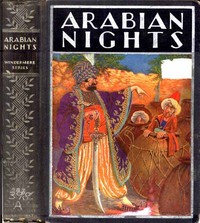
As you read, pay attention to how the tale uses repetition—of phrases, actions, and character types—to build tension and deliver moral lessons. The story rewards careful observation of small details, such as the number of jars or the price of a cobbler's silence. The incomplete excerpt leaves the captain's plot hanging, inviting the reader to anticipate how Morgiana might foil it. This edition, published by J. Wrigley as a "colored toy book," suggests a visual element that the text alone cannot convey, but the brisk, action-driven prose remains the primary engine of the tale.
There’s something about Morgiana’s quiet cunning that stays with you long after the last page, the way an old friend’s cleverness lingers in memory. This companion made me feel like I was reading beside someone who knew the tale intimately. It also reminded me of wandering further into that same world with The Arabian Nights Entertainments — Volume 03 — Inside the Classic, where every turn feels familiar yet somehow new.
There are no reviews for this eBook.
There are no comments for this eBook.
Reader reflection
How will you remember this book?
Save your reaction, strongest insight, and memorable passage.
Your progress
0
/
10
2
Did this book hold your interest?
3
Would you recommend this book to another reader?
4
How much effort did this book require?
5
What did you appreciate most?
6
Could you follow the author’s main argument?
7
Would you start a conversation about this book?
8
Did the book meet your expectations?
9
Which lesson or insight stayed with you?
10