1

The Arabian Nights Entertainments — Edition Insights
(0 User reviews)
458
Project Gutenberg
2006
Not confirmed
Fairy tales; Folklore -- Arab countries
Readers of public-domain and historical texts
Project Gutenberg digital edition
en
Edition facts
Words
90,106
Reading time
392 min
Text sections
9
The catalog record for The Arabian Nights Entertainments — Edition Insights provides practical reading context through 90,106 words, 6 hr 32 min estimated reading time, and 9 detected text sections.
The text analysis averages about 26.0 words per sentence, while the detected sections provide another way to judge how the source is divided.
Project Gutenberg metadata also associates the work with “Fairy tales,” connecting these edition facts with the source record’s subject description.
Source:
Project Gutenberg record #19860
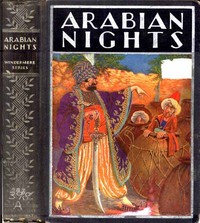
This edition of The Arabian Nights Entertainments uses Dr. Jonathan Scott's 1811 translation, noted for its direct and simple style. The introduction traces the tales' journey from Persian and Hindu origins through 16th-century Egypt to Europe via Antoine Galland. Milo Winter's illustrations accompany stories framed by Schehera-zade's life-saving storytelling.
Editorial Edition Score
4.8/5
★★★★★
★★★★★
Calculated from edition completeness, EPUB availability, text structure and catalogue metadata. Not a user rating.
How this score is calculated
- Description quality20 pts
- Title & short description10 pts
- Source metadata20 pts
- Text length15 pts
- Chapters / structure15 pts
- EPUB file integrity20 pts
Total of 100 points, scaled to a 2.5-5.0 range. Editions with an empty description or a missing EPUB file are not scored.
Edition quality
Public-domain source text
Read the source text
The source text is kept in the dedicated reader, separate from this catalogue record and its commentary.
The present edition of The Arabian Nights Entertainments reproduces Dr. Jonathan Scott's 1811 translation, which the introduction praises for its 'style admirably direct, easy, and simple.' Unlike Antoine Galland's earlier French version—which sparked such fervor in Paris that young men reportedly roused the translator from sleep demanding more tales—Scott's text aims for a more accurate rendering from the Arabic. The volume includes illustrations by Milo Winter, whose visual interpretations complement the narratives without overwhelming them.
The framing story of Schehera-zade, who wins a day's reprieve from execution each night by captivating King Shahryar with a tale, is briefly outlined in the introduction. The tales themselves, though set in Persia or India, are described as 'thoroughly Mohammedan in thought, feeling, situation, and action,' with a particular fondness for ninth-century Baghdad and its caliph, Haroun al Raschid.
Diction and the Translator's Hand
Scott's translation favors a plain, declarative syntax that moves the action forward without ornate digression. In the excerpt from the tale of the two princes and the princess, the emperor says to his queen: 'I come to entreat your pardon for the injustice I have done you.' The sentence is direct, its emotional weight carried by the verb 'entreat' and the noun 'injustice.' There is no elaborate apology; the language mirrors the formal yet sincere tone of a ruler making amends. Similarly, when the queen is described as having 'languished under' confinement 'for so many years,' the verb 'languished' conveys prolonged suffering without melodrama. Scott's choices keep the focus on the characters' actions and feelings rather than on decorative prose.
Voice and the Role of the Narrator
The narrative voice in these tales is omniscient but restrained, reporting events with a matter-of-factness that lends credibility to the fantastical. When the emperor 'presented the Princes Bahman and Perviz and the Princess Perie-zadeh to their enraptured mother,' the narrator does not dwell on the mother's inner state; instead, the phrase 'enraptured mother' is the only direct indication of emotion, leaving the reader to infer the depth of her joy from the context. This economy of emotional description is characteristic of the collection: the narrator trusts the events themselves to stir the reader. The voice also occasionally steps back to offer explanatory footnotes, as when a note clarifies that 'Parizadeh... signifies born of a fairy,' grounding the story in cultural etymology without breaking the narrative flow.
Structure and the Art of Repetition
The excerpt demonstrates a structural pattern common to many tales in the collection: a resolution scene that gathers characters, restores order, and culminates in public celebration. The emperor's journey to the mosque, the embrace, the change of dress, the presentation of children, the repast, the garden tour, and the return to the capital form a sequence of ritualistic steps. Each action is described in a separate sentence or short paragraph, creating a cumulative rhythm. The repetition of 'the two princes and the princess' and the listing of their names—Bahman, Perviz, Perie-zadeh—reinforces their importance and the symmetry of the family reunion. This structured repetition, almost ceremonial, gives the tale a sense of closure that satisfies the listener's expectation of justice restored.
Setting and the Senses: Sound and Sight
The setting in the excerpt is evoked through sensory details that serve the plot rather than mere atmosphere. The speaking-bird, introduced as 'the harmonious-tree and the beautiful yellow-fountain' are shown to the queen, but it is the bird's song that draws 'all the other birds about him, which followed him, flying from tree to tree.' Sound becomes a visible phenomenon: the bird's 'sweet notes' create a procession of avian followers that accompanies the royal party into the city. The visual spectacle of 'illuminations and rejoicings' at night contrasts with the earlier 'miserable condition' of the queen, emphasizing the transformation. The setting is not static; it changes with the emotional arc, from the mosque door to the garden to the palace, each location marking a step in the reconciliation.
Readers approaching this edition should attend to the interplay between Scott's restrained translation and the extraordinary events it describes. The tales reward attention to small verbal choices—a single verb like 'languished' or 'entreat' can carry the emotional weight of a scene. The footnotes, though few, offer glimpses into the cultural assumptions behind the stories, such as the Arabian science of understanding bird language. Let the stories unfold at their own pace, and note how the narrator's calm voice makes even the most improbable reunion feel inevitable.
I finished that Arabian Nights edition the other day, and something about Schehera-zade’s quiet persistence stayed with me—the way stories can hold off the dark just a little longer. It reminded me of how certain old collections feel like a warm hand on your shoulder. Swiss Fairy Tales — Background and Themes carries that same gentle weight, familiar and strange at once.
There are no reviews for this eBook.
There are no comments for this eBook.
Reader reflection
Before you leave, reflect on the book
Use these questions to collect your thoughts before moving on.
Your progress
0
/
10
2
Was reading this book enjoyable?
3
How likely are you to recommend this book?
4
How demanding did the text feel?
5
How distinctive were its ideas or approach?
6
Could you follow the author’s main argument?
7
Would you start a conversation about this book?
8
How did the reading compare with what you expected?
9
What changed or sharpened your thinking?
10