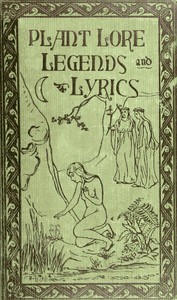
Plant Lore, Legends, and Lyrics Embracing the Myths, Traditions, Superstitions, and Folk-Lore of the Plant Kingdom — Reading Companion

(1 User reviews)   272
In Category - Myths Legends
Folkard, Richard Project Gutenberg 2014
Plants -- Folklore Readers of public-domain and historical texts
Project Gutenberg digital edition en

Edition facts

Words 300,104
Reading time 1305 min
Text sections 48

The catalog record for Plant Lore, Legends, and Lyrics Embracing the Myths, Traditions, Superstitions, and Folk-Lore of the Plant Kingdom — Reading Companion provides practical reading context through 300,104 words, 21 hr 45 min estimated reading time, and 48 detected text sections.

The text analysis averages about 27.5 words per sentence, while the detected sections provide another way to judge how the source is divided.

Project Gutenberg metadata also associates the work with “Plants -- Folklore,” connecting these edition facts with the source record’s subject description.

Richard Folkard's 1884 compendium organizes plant myths, traditions, and superstitions into a digest and a detailed second section, drawing on European and Indian sources. Entries like the Dragon-tree and Durian blend botanical description with folklore, revealing how cultural beliefs shape the perception of plants.
Share
Editorial Edition Score 4.9/5

Calculated from edition completeness, EPUB availability, text structure and catalogue metadata. Not a user rating.

How this score is calculated
  • Description quality20 pts
  • Title & short description10 pts
  • Source metadata20 pts
  • Text length15 pts
  • Chapters / structure15 pts
  • EPUB file integrity20 pts

Total of 100 points, scaled to a 2.5-5.0 range. Editions with an empty description or a missing EPUB file are not scored.

Edition quality

Read the Text

radise of the Persians, Arabians, Hindus, Scandinavians, and Celts -- The Mosaic Paradise -- Eden and the Walls of its Garden -- The Tree of Life -- The Tree of Knowledge -- The Forbidden Fruit -- Adam’s Departure from Paradise -- Seth’s Journey to the Garden of Eden -- The Death of Adam -- The Seeds of the Tree of Life -- Moses and his Rods -- King David and the Rods -- Solomon and the Cedars of Lebanon -- The Tree of Adam and the Tree of the Cross 9

SACRED PLANTS OF THE ANCIENTS. -- The Parsis and the Cypress -- The Oak -- Sacred Plants and Trees of the Brahmans and Buddhists -- Plants Revered by the Burmans -- The Cedar, Elm, Ash, Rowan, Baobab, Nipa, Dragon Tree, Zamang, and Moriche Palm -- The Nelumbo or Sacred Bean -- Plants Worshipped by Egyptians -- The Lotus, Henna, and Pomegranate -- Sacred Plants of the Græco-Roman Divinities -- Plants of the Norse Gods 21

FLORAL CEREMONIES, GARLANDS, AND WREATHS. -- The Altars of the Gods -- Flowers, Fragrant Woods, and Aromatics -- Incense -- Perfumes -- Ceremonies of the Assyrians, Egyptians, Greeks, and Romans -- The Roman Triumphs -- Festivals of the Terminalia and Floralia -- May-day Customs -- Well-flowering -- Harvest Festivals -- Flowers and Weddings -- Floral Games of Toulouse and Salency -- The Rosière -- Rose Pelting -- Battle of Flowers -- Japanese New Year’s Festival -- Wreaths, Chaplets, and Garlands 26

PLANTS OF THE CHRISTIAN CHURCH. -- The Virgin Mary and her Flowers -- Joseph’s Plants -- The Plants of Bethlehem -- Flora of the Flight into Egypt -- The Herb of the Madonna -- Plants of the Virgin -- The Annunciation, Visitation, and Assumption -- The Rosary -- The Plants of Christmas -- The Garden of Gethsemane -- Plants of the Passion -- The Crown of Thorns -- The Wood of the Cross -- Veronica -- The Plants of Calvary -- The Trees and the Crucifixion -- The Tree of Judas -- Plants of St. John the Baptist -- Plant Divination on St. John’s Eve -- Flowers of the Saints -- The Floral Calendar -- Flowers of the Church’s Festivals -- Decoration of Churches -- Gospel Oaks -- Memorial Trees -- The Glastonbury Thorn -- St. Joseph’s Walnut Tree -- St. Martin’s Yew 40

PLANTS OF THE FAIRIES AND NAIADES. -- The Elves and the Oak -- Elves of the Forest -- The Elf of the Fir-tree -- The Rose Elf -- Moss or Wood Folk -- The Black Dwarfs -- The Still Folk -- The Procca -- English Fairies -- The Fairy Steed -- Fairy Revels -- Elf Grass -- Fairy Plants -- The Cowslip, or Fairy Cup -- The Foxglove, or Lusmore -- The Four-leaved Clover -- The Fairy Unguent -- The Russalkis -- Naiades and Water Nymphs -- The Fontinalia -- Fays of the Well 64

SYLVANS, WOOD NYMPHS, AND TREE SPIRITS. -- Fauns, Satyrs, Dryads, and Hamadryads -- The Laurel Maiden -- The Willow Nymph -- The Sister of the Flowers -- Sacred Groves and their Denizens -- The Spirits of the Forest -- The Indian Tree Ghosts -- The Burmese Nats -- The African Wood Spirits -- The Waldgeister of the Germans -- The Elder-mother -- German Tree and Field Spirits 74

PLANTS OF THE DEVIL. -- Puck’s Plant -- Pixie-stools -- Loki’s Plants -- The Trolls and the Globe-flower -- Accursed and Unlucky Plants -- Plants connected with the Black Art -- Plant-haunting Demons -- The Devil and Fruit Trees -- Tree Demons on St. John’s Eve -- Demons of the Woods and Fields -- The Herb of the Devil -- Poisonous and Noxious Plants -- Ill-omened Plants -- The Devil’s Key -- Plants Inimical to the Devil -- The Devil-Chaser -- The Deadly Upas -- The Manchineel -- The Oleander -- The Jatropha Urens -- The Lotos -- The Elder -- The Phallus Impudicus -- The Carrion Flower -- The Antchar -- The Loco or Rattle Weed -- The Aquapura -- Deadly Trees of Hispaniola and New Andalusia -- Poisonous Plants 82

PLANTS OF THE WITCHES. -- The Herbs of Hecate, Circe, and Medea -- Witch Powder -- Witches and Elders -- Sylvan Haunts of Witches -- Witches’ Plant-steeds -- Witches’ Soporifics -- The Nightmare Flower -- Plants used in Spells -- Potions, Philtres, and Hell-broths -- The Hag Taper -- Witch Ointment -- The Witches’ Bath -- Foreign Witches and their Plants -- Plants used for Charms and Spells -- Witches’ Prescriptions -- Herbs of Witchcraft -- Plants Antagonistic to Witches 91

MAGICAL PLANTS. -- Plants producing Ecstasies and Visions -- Soma -- Laurel -- The Druids and Mistletoe -- Prophetic Oaks -- Dream Plants -- Plants producing Love and Sympathy -- The Sorcerer’s Violet -- Plants used for Love Divination -- Concordia -- Discordia -- The Calumny Destroyer -- The Grief Charmer -- The Sallow, Sacred Basil, Eugenia, Onion, Bay, Juniper, Peony, Hypericum, Rowan, Elder, Thorn, Hazel, Holly -- The Mystic Fern-seed -- Four-leaved Clover -- The Mandrake, or Sorcerer’s Root -- The Metal Melter -- The Misleading Plant -- Herb of Oblivion -- Lotos Tree -- King Solomon’s Magical Herb Baharas -- The Nyctilopa and Springwort -- Plants influencing Thunder and Lightning -- The Selago, or Druid’s Golden Herb -- Gold-producing Plants -- Plants which disclose Treasures -- The Luck Flower -- The Key-Flower -- Sesame -- The Herb that Opens -- The Moonwort, or Lunary -- The Sferracavallo -- Magic Wands and Divining Rods -- Moses’ Rod 105

FABULOUS, WONDROUS, AND MIRACULOUS PLANTS. -- Human Trees -- Man-bearing Trees -- The Wak-Wak, or Tree bearing Human Heads -- Chinese and Indian Bird-bearing Tree -- Duck-bearing Tree -- The Barnacle, or Goose Tree -- The Serpent-bearing Tree -- The Oyster-bearing Tree -- The Animal-bearing Tree -- The Butterfly-bearing Tree -- The Vegetable Lamb -- The Lamb-bearing Tree -- Marvellous Trees and Plants -- Vegetable Monstrosities -- Plants bearing Inscriptions and Figures -- Miraculous Plants -- The Tree of St. Thomas -- The Withered Tree of the Sun -- The Tree of Tiberias -- Father Garnet’s Straw 116

PLANTS CONNECTED WITH BIRDS AND ANIMALS. -- Seed-sowing Birds -- Birds as Almanacks -- The Cuckoo and the Cherry Tree -- Augury by Cock and Barley -- The Nightingale and the Rose -- The Robin and the Thorn -- The Missel-Thrush and Mistletoe -- The Swallow and Celandine -- The Hawk and Hawkweed -- Life-giving Herb -- The Woodpecker and the Peony -- The Spring-wort and the Birds -- Choughs and Olives -- Herb of the Blessed Virgin Mary -- The Eyebright and Birds -- Plants named after Birds and Animals 136

THE DOCTRINE OF PLANT SIGNATURES. -- Illustrations and Examples of the Signatures and Characterisms of Plants -- The Diseases Cured by Herbs -- General Rules of the System of Plant Signatures supposed to Reveal the Occult Powers and Virtues of Vegetables -- Plants Identified with the Various Portions of the Human Body -- The Old Herbals and Herbalists -- Extraordinary Properties attributed to Herbs 154

PLANTS AND THE PLANETS. -- When to Pluck Herbs -- The Plants of Saturn, Jupiter, Mars, Venus, Mercury, the Sun, and the Moon -- Sun Flowers -- The Influence of the Moon on Plants -- Times and Seasons to Sow and Plant -- The Moon and Gardening Operations -- The Moon-Tree -- Plants of the Moon-Goddesses -- The Man in the Moon 164

PLANT SYMBOLISM AND LANGUAGE. -- Plant Emblems of the Ancients -- The Science of Plant Symbolism -- Floral Symbols of the Scriptures -- The Passion Flower, or Flower of the Five Wounds -- Mediæval Plant Symbolism -- Floral Emblems of Shakspeare -- The Language of Flowers -- Floral Vocabulary of the Greeks and Romans -- A Dictionary of Flowers -- Floral Divination 176

FUNERAL PLANTS. -- The Ancient Death-Gods -- The Elysian Fields -- Death Trees -- Funereal Trees -- Aloe, Yew, Cypress, Bay, Arbor-Vitæ, Walnut, Mountain Ash, Tamarisk -- The Decorations of Tombs -- Flowers at Funerals -- Old English Burial Customs -- Funeral Pyres -- Embalming -- Mummies -- Plants as Death Portents 189

AN ENCYCLOPÆDIA OF SIX HUNDRED PLANTS, ENGLISH AND FOREIGN, giving their Myths, Legends, Traditions, Folk-Lore, Symbolism, and History 205

List of Illustrations.

GATHERING THE SELAGO (_drawn by Louis Absolon_) Cover.

THE GARDEN OF EDEN (_Parkinson’s Paradisus_) Frontispiece.

YGGDRASILL, THE MUNDANE ASH (_Finn Magnusen_) 2

RELICS OF THE CRUCIFIXION (_Maundevile’s Travels_) 45

THE TREE OF JUDAS ISCARIOT (_Maundevile’s Travels_) 49

THE BARNACLE TREE (_Aldrovandi Ornithologia_) 118

THE GOOSE TREE (_Gerarde’s Herbal_) 119

THE BAROMETZ, OR VEGETABLE LAMB (_Zahn_) 121

THE LAMB TREE (_Maundevile’s Travels_) 122

DEAD SEA FRUIT (_Maundevile’s Travels_) 125

THE STONE TREE (_Gerarde’s Herbal_) 126

ARBOR SECCO, OR THE WITHERED TREE (_Maundevile’s Travels_) 131

THE MIRACULOUS TREE OF TIBERIAS (_Maundevile’s Travels_) 132

FATHER GARNET’S STRAW (_Apology of Eudæmon Joannes_) 135

PIOUS BIRDS AND OLIVES (_Maundevile’s Travels_) 143

THE PASSION FLOWER OF THE JESUITS (_Parkinson’s Paradisus_) 182

THE TREE OF DEATH (_Maundevile’s Travels_) 190

THE GRANADILLA, OR PASSION FLOWER (_Zahn_) 487

The head and tail pieces on pp. xiii., xxiv., 1, 8, 20, 21, 26, 40, 64, 74, 116, 136, 164, 175, 200, 592, and 610, are reproductions from originals in old herbals, &c.

The analogy existing between the vegetable and animal worlds, and the resemblances between human and tree life, have been observed by man from the most remote periods of which we have any records. Primitive man, watching the marvellous changes in trees and plants, which accurately marked not only the seasons of the year, but even the periods of time in a day, could not fail to be struck with a feeling of awe at the mysterious invisible power which silently guided such wondrous and incomprehensible operations. Hence it is not astonishing that the early inhabitants of the earth should have invested with supernatural attributes the tree, which in the gloom and chill of Winter stood gaunt, bare, and sterile, but in the early Spring hastened to greet the welcome warmth-giving Sun by investing itself with a brilliant canopy of verdure, and in the scorching heat of Summer afforded a refreshing shade beneath its leafy boughs. So we find these men of old, who had learnt to reverence the mysteries of vegetation, forming conceptions of vast cosmogonic world- or cloud-trees overshadowing the universe; mystically typifying creation and regeneration, and yielding the divine ambrosia or food of immortality, the refreshing and life-inspiring rain, and the mystic fruit which imparted knowledge and wisdom to those who partook of it. So, again, we find these nebulous overspreading world-trees connected with the mysteries of death, and giving shelter to the souls of the departed in the solemn shade of their dense foliage.

Looking upon vegetation as symbolical of life and generation, man, in course of time, connected the origin of his species with these shadowy cloud-trees, and hence arose the belief that humankind first sprang from Ash and Oak-trees, or derived their being from Holda, the cloud-goddess who combined in her person the form of a lovely woman and the trunk of a mighty tree. In after years trees were almost universally regarded either as sentient beings or as constituting the abiding places of spirits whose existence was bound up in the lives of the trees they inhabited. Hence arose the conceptions of Hamadryads, Dryads, Sylvans, Tree-nymphs, Elves, Fairies, and other beneficent spirits who peopled forests and dwelt in individual trees--not only in the Old World, but in the dense woods of North America, where the Mik-amwes, like Puck, has from time immemorial frolicked by moonlight in the forest openings. Hence, also, sprang up the morbid notion of trees being haunted by demons, mischievous imps, ghosts, nats, and evil spirits, whom it was deemed by the ignorant and superstitious necessary to propitiate by sacrifices, offerings, and mysterious rites and dances. Remnants of this superstitious tree-worship are still extant in some European countries. The _Irminsul_ of the Germans and the Central Oak of the Druids were of the same family as the _Asherah_ of the Semitic nations. In England, this primeval superstition has its descendants in the village maypole bedizened with ribbons and flowers, and the Jack-in-the-Green with its attendant devotees and whirling dancers. The modern Christmas-tree, too, although but slightly known in Germany at the beginning of the present century, is evidently a remnant of the pagan tree-worship; and it is somewhat remarkable that a similar tree is common among the Burmese, who call it the _Padaytha-bin_. This Turanian Christmas-tree is made by the inhabitants of towns, who deck its Bamboo twigs with all sorts of presents, and pile its roots with blankets, cloth, earthenware, and other useful articles. The wealthier classes contribute sometimes a _Ngway Padaytha_, or silver Padaytha, the branches of which are hung with rupees and smaller silver coins wrapped in tinsel or coloured paper. These trees are first carried in procession, and afterwards given to monasteries on the occasion of certain festivals or the funerals of Buddhist monks. They represent the wishing-tree, which, according to Burmese mythology, grows in the Northern Island and heaven of the nats or spirits, where it bears on its fairy branches whatever may be wished for.

The ancient conception of human trees can be traced in the superstitious endeavours of ignorant peasants to get rid of diseases by transferring them to vicarious trees, or rather to the spirits who are supposed to dwell in them; and it is the same idea that impels simple rustics to bury Elder-sticks and Peach-leaves to which they have imparted warts, &c. The recognised analogy between the life of plants and that of man, and the cherished superstition that trees were the homes of living and sentient spirits, undoubtedly influenced the poets of the ancients in forming their conceptions of heroes and heroines metamorphosed into trees and flowers; and traces of the old belief are to be found in the custom of planting a tree on the birth of an infant; the tree being thought to symbolise human life in its destiny of growth, production of fruit, and multiplication of its species; and, when fully grown, giving shade, shelter, and protection. This pleasant rite is still extant in our country as well as in Germany, France, Italy, and Russia; and from it has probably arisen a custom now becoming very general of planting a tree to commemorate any special occasion. Nor is the belief confined to the Old World, for Mr. Leland has quite recently told us that he observed near the tent of a North American Indian two small evergreens, which were most carefully tended. On enquiry he found the reason to be that when a child is born, or is yet young, its parent chooses a shrub, which growing as the child grows, will, during the child’s absence, or even in after years, indicate by its appearance whether the human counterpart be ill or well, alive or dead. In one of the Quādi Indian stories it is by means of the sympathetic tree that the hero learns his brother’s death.

In the middle ages, the old belief in trees possessing intelligence was utilised by the monks, who have embodied the conception in many mediæval legends, wherein trees are represented as bending their boughs and offering their fruits to the Virgin and her Divine Infant. So, again, during the flight of the Holy Family into Egypt, trees are said to have opened and concealed the fugitives from Herod’s brutal soldiery. Certain trees (notably the Aspen) are reputed to have been accursed and to have shuddered and trembled ever after on account of their connexion with the tragedy of Calvary; while others are said to have undergone a similar doom because they were attainted by the suicide of the traitor Judas Iscariot.

Seeing that the reverence and worship paid to trees by the ignorant and superstitious people was an institution impossible to uproot, the early Christian Church sought to turn it to account, and therefore consecrated old and venerated trees, built shrines beneath their shade, or placed on their trunks crucifixes and images of the Blessed Virgin. Legends connecting trees with holy personages, miracles, and sacred subjects were, in after years, freely disseminated; one of the most remarkable being the marvellous history of the Tree of Adam, in which it is sought to connect the Tree of Paradise with the Tree of Calvary. Evelyn summarises this misty tradition in the following sentence:--“Trees and woods have twice saved the whole world: first, by the Ark, then by the Cross; making full amends for the evil fruit of the tree in Paradise by that which was borne on the tree in Golgotha.” In course of time the flowers and plants which the ancients had dedicated to their pagan deities were transferred by the Christian Church to the shrines of the Virgin and sainted personages; this is especially noticeable in the plants formerly dedicated to Venus and Freyja, which, as being the choicest as well as the most popular, became, in honour of the Virgin Mary, Our Lady’s plants. Vast numbers of flowers were in course of time appropriated by the Church, and consecrated to her saints and martyrs--the selection being governed generally by the fact that the flower bloomed on or about the day on which the Church celebrated the saint’s feast. These appropriations enabled the Roman Catholics to compile a complete calendar of flowers for every day in the year, in which each flower is dedicated to a particular saint.

But if the most beautiful flowers and plants were taken under the protection of the Church, and dedicated to the memory of her holiest and most venerated members, so, also, certain trees, plants, and flowers--which, either on account of their noxious properties, or because of some legendary associations, were under a ban--became relegated to the service of the Devil and his minions. Hence we find a large group of plants associated with enchanters, sorcerers, wizards and witches, many of which betray in their nomenclature their Satanic association, and are, even at the present day, regarded suspiciously as ill-omened and unlucky. These are the plants which, in the dark days of witchcraft and superstition, were invested with mysterious and magical properties,--the herbs which were employed by hags and witches in their heathenish incantations, and from which they brewed their potions and hell-broths. Thus Ben Jonson, in his fragment, ‘The Sad Shepherd,’ makes one of his characters say, when speaking of a witch:--

“He knows her shifts and haunts, And all her wiles and turns. The venom’d plants Wherewith she kills! where the sad Mandrake grows, Whose groans are dreadful! the dead-numming Nightshade! The stupefying Hemlock! Adder’s-tongue! And Martagan!”

The association of plants with magic, sorcery, and the black art dates from remote times. The blind Norse god Hödr slew Baldr with a twig of Mistletoe. In the battles recorded in the Vedas as being fought by the gods and the demons, the latter employ poisonous and magical herbs which the gods counteract with counter-poisons and health-giving plants. Hermes presented to Ulysses the magical Moly wherewith to nullify the effects of the potions and spells of the enchantress Circe, who was well acquainted with all sorts of magical herbs. The Druids professed to know the secrets of many magical plants which they gathered with mysterious and occult rites. The Vervain, Selago, Mistletoe, Oak, and Rowan were all said by these ancient priests and lawgivers to be possessed of supernatural properties; and remnants of the old belief in their magical powers are still extant.

Richard Folkard's Plant Lore, Legends, and Lyrics (1884) opens with a preface that reveals its dual structure: a digest of the second section, designed for easy reference. Folkard, serving as both author and printer, acknowledges his debt to Angelo De Gubernatis's La Mythologie des Plantes for Continental and Indian lore. The work's entries, such as those on the Dracæna and Durian, intertwine botanical description with mythic narratives, showing how plants become vessels for cultural meaning.

A Dual Structure for Plant Lore

Folkard divides his volume into two sections: a digest and a fuller treatment. The preface explains that the first section is a digest of the second, aiming to make the work comprehensive and easy to reference. This structure suggests that readers might use the digest for quick consultation and the second section for deeper exploration. The inclusion of curious illustrations further enhances the reference value. Folkard's dual role as author and printer is noted with a wry remark that he cannot blame 'errors of the press' for mistakes. The list of principal works cited—from Albertus Magnus to Darwin—indicates the breadth of sources consulted.

The Dragon-tree: Botany and Belief

The entry on the Dracæna, or Dragon-tree, exemplifies how Folkard blends natural history with legend. He quotes Gerarde's description of the tree's bark yielding 'Dragon's Tears, or Sanguis Draconis,' a medicinal gum. The tree's berries supposedly contain a dragon-shaped form. Folkard recounts that the Guanches worshipped a venerable Dragon-tree at Orotava, which Humboldt saw in 1799. Humboldt's description—'its aspect feelingly recalls to mind that eternal youth of Nature'—is quoted, though the tree was later destroyed by storms. This entry moves from botanical detail to cultural veneration, showing how a plant can become sacred.

Contrasts in Fruit: Durian and Durva

Two entries highlight contrasting cultural valuations. The Durian, 'king of fruit' to Malays, has a custard-like pulp that resembles cream but emits an 'intolerable stench' compared to putrid animal substances. Folkard notes that despite the repugnance, the fruit is highly enjoyable once overcome. In contrast, the Durva grass is revered in Hindu tradition; the Atharvaveda implores it to grant absolution for a hundred faults and prolong life. The grass is described as tender, fresh, and substantial cattle food. These entries show how the same plant can be both repellent and prized, or humble and sacred, depending on cultural context.

Folkard's compilation invites readers to move between the digest and the detailed entries, observing how plants accumulate layers of meaning across cultures. The work's strength lies in its juxtaposition of botanical fact with myth, superstition, and ritual. Readers may find it useful to compare entries on similar plants from different traditions, noting how the same species can carry divergent symbolic weights.

There’s something tender about old books that take plants seriously as storytellers, the way Folkard does with his dragon-trees and durians. My copy feels like a quiet afternoon in a borrowed garden. It made me think of other rooted places, other voices. I keep returning to The Legends and Myths of Hawaii: The fables and folk-lore of a strange people — A Reader’s Guide, where the same gentle hush of belonging lingers.

Isabella Thompson
3 weeks ago

4
4 out of 5 (1 User reviews )

Add a Review

Your Rating *
There are no comments for this eBook.

Reader reflection

How did this book work for you?

Your answers remain private and are stored only in this browser.

Your progress 0 / 10
1

Where are you in your reading?

2

Was reading this book enjoyable?

3

How likely are you to recommend this book?

4

What was the reading difficulty like?

Related eBooks