1

Child-Life in Japan and Japanese Child Stories — Background and Themes
(0 User reviews)
3021
Project Gutenberg
2009
Not confirmed
Japan -- Social life and customs; Fairy tales -- Japan; Children -- Japan
Readers of public-domain and historical texts
Project Gutenberg digital edition
en
Edition facts
Words
21,601
Reading time
94 min
Text sections
4
For Child-Life in Japan and Japanese Child Stories — Background and Themes, the stored edition analysis reports 21,601 words, 1 hr 34 min estimated reading time, and 4 detected text sections.
The text analysis averages about 16.5 words per sentence, while the detected sections provide another way to judge how the source is divided.
Project Gutenberg metadata also associates the work with “Japan -- Social life and customs,” connecting these edition facts with the source record’s subject description.
Source:
Project Gutenberg record #28979
This editorial note examines Matilda Chaplin Ayrton's observations of Japanese children's games, festivals, and home life in the late 19th century, focusing on her descriptive choices, the interplay of foreign and local perspectives, and the editorial adjustments by William Elliot Griffis for an American audience.
Editorial Edition Score
4.6/5
★★★★★
★★★★★
Calculated from edition completeness, EPUB availability, text structure and catalogue metadata. Not a user rating.
How this score is calculated
- Description quality20 pts
- Title & short description10 pts
- Source metadata20 pts
- Text length15 pts
- Chapters / structure15 pts
- EPUB file integrity20 pts
Total of 100 points, scaled to a 2.5-5.0 range. Editions with an empty description or a missing EPUB file are not scored.
Edition quality
Read the Text
was the laughter in the morning when they related their dreams. Yoshi-san said he had dreamt he had a beautiful portmanteau full of nice foreign things, such as comforters, note-books, pencils, india-rubber, condensed milk, lama, wide-awakes, boots, and brass jewelry. Just as he opened it, everything vanished and he found only a torn fan, an odd chop-stick, a horse's cast straw shoe, and a live crow.
When at home, the children, for the first few days of the New Year, dressed in their best crepe, made up in three silken-wadded layers. Their crest was embroidered on the centre of the back and on the sleeves of the quaintly flowered long upper skirt. Beneath its wadded hem peeped the scarlet rolls of the hems of their under-dresses, and then the white-stockinged feet, with, passing between the toes, the scarlet thong of the black-lacquered clog. The little girl's sash was of many-flowered brocade, with scarlet broidered pouch hanging at her right side. A scarlet over-sash kept the large sash-knot in its place. Her hair was gay with knot of scarlet crinkled crepe, lacquered comb, and hairpin of tiny golden battledore. Resting thereon were a shuttlecock of coral, another pin of a tiny red lobster and a green pine sprig made of silk. In her belt was coquettishly stuck the butterfly-broidered case that held her quire of paper pocket-handkerchiefs. The brother's dress was of a simpler style and soberer coloring. His pouch of purple had a dragon worked on it, and the hair of his partly shaven head was tied into a little gummed tail with white paper-string. They spent most of the day playing with their pretty new battledores, striking with its plain side the airy little shuttlecock whose head is made of a black seed. All the while they sang a rhyme on the numbers up to ten:--
"Hitogo ni futa-go--mi-watashi yo me-go, Itsu yoni musashi nan no yakushi, Kokono-ya ja--to yo."
When tired of this fun, they would play with a ball made of paper and wadding evenly wound about with thread or silk of various colors. They sang to the throws a song which seems abrupt because some portions have probably fallen into disuse; it runs thus:--
"See opposite--see Shin-kawa! A very beautiful lady who is one of the daughters of a chief magistrate of Odawara-cho. She was married to a salt merchant. He was a man fond of display, and he thought how he would dress her this year. He said to the dyer, 'Please dye this brocade and the brocade for the middle dress into seven-or eight-fold dresses;' and the dyer said, 'I am a dyer, and therefore I will dye and stretch it. What pattern do you wish?' The merchant replied, 'The pattern of falling snow and broken twigs, and in the centre the curved bridge of Gojo.'"
Then to fill up the rhyme come the words, "Chokin, chokera, kokin, kokera," and the tale goes on: "Crossing this bridge the girl was struck here and there, and the tea-house girls laughed. Put out of countenance by this ridicule, she drowned herself in the river Karas, the body sunk, the hair floated. How full of grief the husband's heart--now the ball counts a hundred."
This they varied with another song:--
"One, two, three, four, Grate hard charcoal, shave kiri wood; Put in the pocket, the pocket is wet, Kiyomadzu, on three yenoki trees Were three sparrows, chased by a pigeon. The sparrows said, 'Chiu, chiu,' The pigeon said, 'po, po,'--now the Ball counts a hundred."
The pocket referred to means the bottom of the long sleeve, which is apt to trail and get wet when a child stoops at play. Kiyomadzu may mean a famous temple that bears that name. Sometimes they would simply count the turns and make a sort of game of forfeiting and returning the number of rebounds kept up by each.
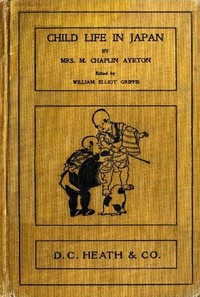
Matilda Chaplin Ayrton's Child-Life in Japan and Japanese Child Stories (1879, edited by William Elliot Griffis in 1901) offers a dual perspective: that of a British mother observing her own child's Japanese nurse and that of a trained scientist (she held degrees in letters, sciences, and medicine). The text blends ethnographic detail with personal anecdote, though the excerpts provided focus on the former. Ayrton's descriptions of street vendors, festival games, and evening entertainments reveal a writer attentive to sensory specifics—the colors of a beetle's wings, the sound of a drum, the stillness of a stormy Tokyo night. Griffis's editorial hand, acknowledged in the preface, adjusts measurements and spelling for American readers while preserving the original's core observations.
Vendors as Performers
Ayrton devotes notable attention to the men and women who make a living by amusing children. She describes the seller of sugar-jelly who “exhibits a devil, taps a drum, and dances” for his baby customers, and the pastry seller who adds “gymnastics and skilful tricks with balls of dough.” These details are not merely catalogued; they are presented as evidence of a commercial culture that treats child amusement as a performance art. The author’s word choice—exhibits, taps, dances—frames these vendors as entertainers first, merchants second. The observation that “in every Japanese city there are scores, if not hundreds” of such people suggests a systemic, not incidental, feature of urban life. Ayrton does not moralize or compare to Western practices; she simply records the scene, letting the reader infer the contrast with, say, a British street seller’s more utilitarian approach.
Festival Games and Gendered Play
The description of New Year’s battledore and shuttlecock reveals Ayrton’s eye for social nuance. Girls, she notes, dress in their best robes, powder their faces, and paint their lips “until they resemble the peculiar colors seen on a beetle’s wings.” The simile is striking—biological, precise, and slightly unsettling—reflecting her scientific training. She observes that the game allows “abundant opportunity for the display of personal beauty, figure, and dress,” and that losers are marked with ink or a circle drawn around the eyes. The boys sing for wind; the girls for calm, so their shuttlecocks “may fly straight.” This gendered contrast in song lyrics is a small but telling detail: it implies different attitudes toward control and risk. Ayrton does not comment on this difference, but her inclusion of it invites the reader to consider how play reinforces social roles.
Night Life and Storytelling
Ayrton addresses a common foreigner’s question: “what the Japanese do at night.” Her answer is sensory and spatial. On fair nights, the hum and bustle of Tokyo tell a blind foreigner it is a city; on stormy nights, the stillness is “unbroken and very impressive.” She describes moonlight dances in castle towns, where young people move “in circles and clapping their hands,” often continuing until dawn. Inside, winter evenings are given to stories: the Samurai father relates “Japanese history and heroic lore” to fire his son with ambition. Ayrton’s phrasing—fire him with enthusiasm—echoes the martial values she attributes to the Samurai class. She does not claim to have witnessed these scenes herself; the preface notes she wrote after returning to England, relying on memory and notes. The passage thus blends firsthand observation with general knowledge, a mix that Griffis’s editing likely sharpened for clarity.
Card Games and the Tokaido
Among the standard New Year amusements, Ayrton highlights a card game featuring “the names and pictures of the fifty-three post-stations between old Yedo and Kioto.” At the Kioto end, players place a few coins. This game is not merely recreational; it maps the Tokaido road, a central artery of Tokugawa Japan. Ayrton’s inclusion of this detail suggests an interest in how play encodes geography and history. The game’s structure—a large sheet on the floor, players moving tokens along stations—turns travel into competition. Griffis’s note that he “translated or omitted hard Japanese words” may have affected this passage; the original likely included more Japanese terms. As presented, the description is functional but evocative, hinting at a world where children learned their country’s layout through play. The editor’s choice to retain this specific game underscores its cultural significance.
Readers should note that this edition is a product of two authors: Ayrton’s original observations and Griffis’s editorial adjustments for an American audience. The preface acknowledges changes to money, distances, and “statements of fact which were once, but are no longer, true.” This layered authorship means the text reflects both a Victorian British woman’s gaze and an American educator’s desire to make Japan accessible. The excerpts give a vivid sense of children’s culture in the 1870s, but the full book likely contains more stories and personal narrative. Approach it as a historical document shaped by its editors as much as its original writer.
I keep returning to that moment in the notebook where Ayrton records the children’s quiet absorption in a bamboo game—how theirs was a watchfulness, not a performance. It made me think of reading The Lost Dryad years ago, when a small green figure’s stillness felt less like escape and more like waiting. Both books hold that hush. The Lost Dryad — A Closer Reading left me with the same ache: worlds observed, not possessed.
There are no reviews for this eBook.
There are no comments for this eBook.
Reader reflection
Record your reading impressions
A brief reflection can help important ideas stay with you longer.
Your progress
0
/
10
2
Was reading this book enjoyable?
3
Would you pass this book on to a friend?
4
Did the language feel accessible?
5
Would you read this book again?
6
Would you like to discuss this book with someone?
7
Could you apply anything you learned?
8
How strongly did the book affect you emotionally?
9
Which lesson or insight stayed with you?
10