1

Myths and Legends of British North America — A Closer Reading
(0 User reviews)
2838
Project Gutenberg
2015
Not confirmed
Indians of North America -- Folklore; Indians of North America -- Canada -- Folklore
Readers of public-domain and historical texts
Project Gutenberg digital edition
en
Edition facts
Words
41,199
Reading time
180 min
Text sections
6
This digital edition of Myths and Legends of British North America — A Closer Reading is described by source-level measurements including 41,199 words, 3 hr estimated reading time, and 6 detected text sections.
The text analysis averages about 12.5 words per sentence, while the detected sections provide another way to judge how the source is divided.
Project Gutenberg metadata also associates the work with “Indians of North America -- Folklore,” connecting these edition facts with the source record’s subject description.
Source:
Project Gutenberg record #48409
Judson's 1917 collection of Indigenous myths from British North America, drawn from ethnographic reports, focuses on origin tales of animals, landscape features, and natural phenomena, with a stated preference for 'quaint, pure, and beautiful' stories.
Editorial Edition Score
4.7/5
★★★★★
★★★★★
Calculated from edition completeness, EPUB availability, text structure and catalogue metadata. Not a user rating.
How this score is calculated
- Description quality20 pts
- Title & short description10 pts
- Source metadata20 pts
- Text length15 pts
- Chapters / structure15 pts
- EPUB file integrity20 pts
Total of 100 points, scaled to a 2.5-5.0 range. Editions with an empty description or a missing EPUB file are not scored.
Edition quality
Read the Text
f the Bella Coola River, and one kept always a fire burning in his house. One could see the smoke, and this fire warned its master, the mountain, whenever an enemy appeared. When Afraid of Nothing came down in her canoe, the fire gave warning. When she approached, the mountain broke her canoe and turned it into stone. So she returned to heaven. The canoe is still there at the foot of the mountain.
Afraid of Nothing is a great warrior. She visits the earth now and then; but when she does, her visits cause sickness and death.
Under the world where she lives is the House of the Sun. Our own earth is an island swimming in the ocean.
CREATION OF THE WORLD
The people were living beyond the sky. They were Wyandots. One day the shaman told the people to dig around the roots of the wild apple tree standing by the chief’s lodge and Indians at once began to dig. The chief’s daughter was lying near by. As the men dug, a sudden noise startled them. They jumped back. They had broken through the floor of the Sky Land, and the tree and the chief’s daughter fell through.
Now the world beneath was a great sheet of water. There was no land anywhere. Swans swimming about on the water heard a peal of thunder. It was the first peal ever heard in this world. When they looked upward, they saw the tree and the strange woman falling from the Sky Land. One of them said, “What strange thing is falling down?” Then he added, “The water will not hold her up. Let us swim together so she will fall upon our backs.” So the chief’s daughter fell upon their backs, and rested there.
After a while one swan said, “What shall we do with her? We cannot swim about this way very long.” The other said, “Let us ask Big Turtle. He will probably call a council. Then we shall know what to do.”
They swam around to Big Turtle and asked him what to do with the woman on their backs. Big Turtle at once sent a runner with a moccasin to the animals, so they came at once for a great council. The council talked a long while. Then someone stood up and asked about the tree. He said perhaps divers might go down and get just a little earth from its roots, if they knew where it had sunk. Big Turtle said, “Yes. If we can get earth, perhaps we might make an island for this woman.” So the swans took them all to the place where the tree had fallen in the waste of waters.
Big Turtle called for divers. First down went Otter, the best of them all. He sank at once out of sight. He was gone a long, long while. At last he came up, but he gasped and was dead. Then Muskrat was sent down. He also was gone a long, long while. Muskrat also died. Next Beaver was sent down to get earth from the roots of the tree. Beaver also was drowned. Many animals were drowned.
Big Turtle called, “Who will offer to go down for the earth?” No one offered himself, until at last Old Toad said she would try. All the animals laughed. Old Toad was very small and very ugly. Big Turtle looked her over, but he said, “Well, you try then.”
Down went Old Toad. At last they could not see her at all, though she went down slowly. Then they waited for her to come back. They waited, and waited, and waited. They began to say, “She will never come back.” Then they saw a little bubble break on the water. Big Turtle said, “Let us swim there. That is where Old Toad is coming up.” So it was done. Then Old Toad came slowly to the surface, close to Big Turtle. She opened her mouth and spat out a few grains of earth that fell on Big Turtle’s shell. Old Toad was done for, too.
Small Turtle at once began to rub the earth around the edge of Big Turtle’s shell. It began to grow into an island. The animals were looking on as it grew. Then the island became large enough for the woman to live on, so she stepped onto the earth. The island grew larger and larger, until it became as large as the world is today.
When an earthquake occurs, it is because Big Turtle moves his foot. Sometimes he gets tired.
HOW THE EARTH WAS FORMED
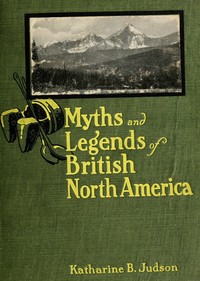
Katharine Berry Judson's Myths and Legends of British North America (1917) gathers tales from tribes spanning Labrador to the Pacific coast, but the editor is explicit about her selective method: she takes only 'the quaint, the pure, and the beautiful' from ethnographic sources, directing readers who want 'pure ethnology, good and bad together' to the original reports. This framing immediately signals that the collection is a curated artifact, not a comprehensive record.
The excerpts reveal a strong emphasis on etiological narratives—stories explaining why animals look or behave as they do. In one Eskimo tale, a child with long ears is laughed at, retreats into the brush, and becomes a hare, still flattening his ears at any shout. Another explains that ravens cry 'Kak, kak, kak!' because the bird, once a man, was sent back for a forgotten blanket and transformed mid-hurry. These compact, moralized origins dominate the sample.
Editorial Selection and Its Limits
Judson's preface acknowledges that the collection omits many stories the Indians told, particularly those involving 'vague, misty, but powerful spirits' above the snowline or references to large lakes and rivers. This self-imposed boundary means the volume skews toward tidy, anthropomorphic explanations rather than the more ambiguous or terrifying aspects of Indigenous cosmology. The catalog subjects—'Indians of North America — Folklore' and 'Indians of North America — Canada — Folklore'—imply a broad survey, but the excerpts show a narrower focus on transformation tales with clear moral or practical takeaways. A reader expecting a full ethnographic range will need to supplement this volume with the original reports Judson cites.
Recurring Narrative Patterns
Several structural habits recur across the excerpts. Many tales begin with a social flaw—poverty, mockery, forgetfulness—that triggers a physical change. The Eastern Eskimo story of wolves, for instance, opens with a poor widow whose many children 'were changed into wolves' because they were always hungry. The transformation is presented as a direct, almost legal consequence. Another pattern is the use of repeated sounds: ravens cry 'Kak, kak, kak!' and hawks cry 'Kea, kea, kea—who, who was it said “short neck”?' These onomatopoeic endings anchor the story in observable animal behavior, giving the myth a mnemonic and performative quality. The tales are short, rarely exceeding a paragraph, and often end with a phrase like 'even yet' to link past and present.
Landscape as a Record of Conflict
Not all stories in the excerpts are about animals. The Shuswap tale of Coyote explains the Chilcotin Cañon as the remnant of a rocky dam Coyote built to block salmon from an upstream tribe he disliked. The dam was eventually 'worn away' by water, allowing salmon to pass. Here, a geological feature is attributed to a trickster's failed scheme, embedding social rivalry into the physical landscape. This contrasts with the animal origin tales, which tend to be individual and punitive. The catalog subject 'Indians of North America — Folklore' does not capture this variety of explanatory scope, from personal transformation to regional geography. Judson's selection, however, gives more weight to the former.
Readers should approach this collection as a deliberately filtered introduction, not a transparent window into Indigenous storytelling. The editor's choices—favoring the 'quaint' and avoiding the 'bad'—shape every page. To understand what was left out, one might consult the ethnographic reports Judson names, or compare these versions with tales recorded by other collectors. The myths themselves reward attention to their compact structure, their use of repeated sounds, and their insistence on linking present-day animal traits to past human actions.
Reading Judson’s collection, I kept noticing how the old stories treated rivers and trees as quiet persons, each with their own patience. That same gentleness came back to me later, flipping through Plant Lore, Legends, and Lyrics Embracing the Myths, Traditions, Superstitions, and Folk-Lore of the Plant Kingdom — Reading Companion. It felt less like a new subject and more like the same hush, just carried over into the garden. Both books seem to listen rather than explain.
There are no reviews for this eBook.
There are no comments for this eBook.
Reader reflection
Your personal reading reflection
Build a private reading journal entry for this title.
Your progress
0
/
10
2
Was reading this book enjoyable?
3
Would you recommend this book to another reader?
4
What was the reading difficulty like?
5
Did you gain anything practical from the text?
6
How closely did the book connect with your experience?
7
Is this a title worth rereading?
8
How clearly were the main ideas presented?
9
In one sentence, what did you learn?
10