1

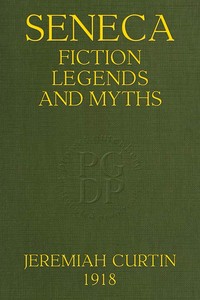
Seneca Fiction, Legends, and Myths Thirty-Second Annual Report of the Bureau of American Ethnology; 1910-1911 — Context and Discussion
(0 User reviews)
1940
Project Gutenberg
2020
Not confirmed
Seneca Indians -- Folklore; Seneca mythology
Readers of public-domain and historical texts
Project Gutenberg digital edition
en
Edition facts
Words
427,469
Reading time
1859 min
Text sections
140
Seneca Fiction, Legends, and Myths Thirty-Second Annual Report of the Bureau of American Ethnology; 1910-1911 — Context and Discussion can be approached with a clearer sense of reading commitment from its source measurements: 427,469 words, 30 hr 59 min estimated reading time, and 140 detected text sections.
The text analysis averages about 18.2 words per sentence, while the detected sections provide another way to judge how the source is divided.
Project Gutenberg metadata also associates the work with “Seneca Indians -- Folklore,” connecting these edition facts with the source record’s subject description.
Source:
Project Gutenberg record #64176
This editorial note examines the structure, recurring images, and scene transitions in Jeremiah Curtin and J. N. B. Hewitt's collection of Seneca narratives, focusing on how movement between domestic and forest settings shapes the tales.
Editorial Edition Score
4.9/5
★★★★★
★★★★★
Calculated from edition completeness, EPUB availability, text structure and catalogue metadata. Not a user rating.
How this score is calculated
- Description quality20 pts
- Title & short description10 pts
- Source metadata20 pts
- Text length15 pts
- Chapters / structure15 pts
- EPUB file integrity20 pts
Total of 100 points, scaled to a 2.5-5.0 range. Editions with an empty description or a missing EPUB file are not scored.
Edition quality
Read the Text
ure of the League. The two chiefships last added to the quota of the Seneca were admitted on condition of their exercising functions belonging to a sergeant-at-arms of a modern legislative body as well as those belonging to a modern secretary of state for foreign affairs, in addition to their duties as federal chieftains; indeed, they became the warders of the famous “Great Black Doorway” of the League of the Iroquois, called Kaʻnhoʻhwădjiʼgōʹnăʻ by the Onondaga.
In historical times the Seneca have been by far the most populous of the five tribes originally composing the League of the Iroquois. The Seneca belong in the federal organization to the tribal phratry known by the political name Hoñdoñnīsʹʻĕⁿʼ, meaning, ‘they are clansmen of the fathers,’ of which the Mohawk are the other member, when the tribes are organized as a federal council; but when ceremonially organized the Onondaga also belong to this phratry. In the federal council the Seneca are represented by eight federal chiefs, but two of these were added to the original six present at the first federal council, to give representation to that part of the tribe which had at first refused to join the League. Since the organization of the League of the Iroquois, approximately in the third quarter of the 16th century, the number of Seneca clans, which are organized into two phratries for the performance of both ceremonial and civil functions, have varied. The names of the following nine have been recorded: Wolf, Hoñnatʻhaiioñʹnĭʻ; Bear, Hodidjioñniʹʼgā; Beaver, Hodigĕⁿʹʼgegāʼ; Turtle, Hadiniăʹʻdĕñʻ; Hawk, Hadisʻhweⁿʹʼgaiiuʼ; Sandpiper, Hodiʼneʻsiʹiuʼ, sometimes also called Snipe, Plover, and Killdeer; Deer, Hadinioñʹgwaiiuʼ; Doe, Hodinoⁿʹʼdeogāʼ, sometimes Hoñnoñtʹgoñdjĕⁿʻ; Heron, Hodidaioⁿʹʼgāʼ. In a list of clan names made in 1838 by Gen. Dearborn from information given him by Mr Cone, an interpreter of the Tonawanda band, the Heron clan is called the Swan clan with the native name given above. Of these clans only five had an unequal representation in the federal council of the League; namely, the Sandpiper, three, the Turtle, two, the Hawk, one, the Wolf, one, and the Bear, one.
One of the earliest known references to the ethnic name Seneca is that on the Original Carte Figurative, annexed to the Memorial presented to the States-General of the Netherlands, Aug. 18, 1616, on which it appears with the Dutch plural as Sennecas. This map is remarkable also for the first known mention of the ancient Erie, sometimes called Gahkwas or Kahkwah; on this map they appear under the name last cited, Gachoi (ch = kh), and were placed on the N. side of the W. branch of the Susquehanna. The name did not originally belong to the Seneca, but to the Oneida, as the following lines will show.
The collection opens with a formal report from the Bureau of American Ethnology, but the narratives themselves begin abruptly in a domestic space: a grandfather and grandson share a meal of freshly killed game. This pattern of movement between home and wilderness recurs throughout the excerpts, with each journey into the forest bringing the protagonist face-to-face with increasingly formidable creatures—from a bird to Neogen, a deer-like being, and finally a bear. The grandfather’s reactions shift from dancing to solemn instruction, marking the youth’s progress toward manhood. The structure of these scenes relies on repeated cycles of departure, encounter, return, and evaluation, creating a rhythm that mirrors the oral tradition from which these stories originate.
Recurring Images of Transformation and Warning
The excerpts feature a striking image of transformation: the young hunter, to avoid a beautiful woman, changes himself into a red-headed woodpecker and climbs higher into a tree. This moment of shape-shifting is preceded by a tree covered in raccoon scratches, a detail that signals the presence of animals before they are seen. The grandfather’s warning about “very wicked women” who killed through sorcery establishes a recurring threat from the east, a direction the youth is forbidden to explore. These images—the marked tree, the bird transformation, the prohibited direction—reappear in different forms across the collection, suggesting a symbolic vocabulary that links physical movement with moral or supernatural danger.
Scene Transitions and the Role of the Grandfather
Each scene in the excerpts is anchored by the grandfather’s response to the youth’s return. After the first hunt, the old man dances and sings; after the killing of Neogen, he becomes solemn and instructs the boy in dressing deer skin. These shifts in tone define the narrative’s progression: the grandfather’s reactions serve as a barometer for the youth’s development. The transition from home to forest is abrupt, often initiated by the youth’s decision to hunt, and the return is marked by the grandfather’s evaluation. The excerpts show no interior monologue or description of the journey itself; instead, the narrative jumps directly to the encounter, emphasizing action over reflection. This structure prioritizes the outcome of each hunt over the process, reinforcing the didactic function of the tales.
The East as a Forbidden Zone
The grandfather’s prohibition against hunting toward the east introduces a spatial taboo that drives the plot. The youth’s decision to ignore this warning and head eastward leads to his encounter with the raccoon-filled tree and the beautiful woman. The east is associated with sorcery and death, yet it is also the direction that yields the most dramatic events. This tension between obedience and curiosity recurs in other Seneca narratives, where forbidden directions or actions often precipitate the central conflict. The excerpts do not reveal the outcome of this transgression, but the pattern suggests that the east functions as a narrative engine, propelling the hero into danger and transformation.
Oral Features in the Written Text
The prose retains markers of oral storytelling: direct address (“My grandson”), repetition of phrases (“he sang and danced, frequently saying”), and formulaic descriptions of hunting and dressing game. The narrative voice shifts between third-person report and embedded dialogue, with the grandfather’s speeches often carrying moral weight. The use of “Now” to introduce new actions (“Now, my grandson will be a great hunter”) mimics the pacing of a spoken tale. These features, combined with the episodic structure, suggest that the compilers aimed to preserve the performative quality of the originals. Readers should attend to these rhythmic patterns, as they reveal how the stories were meant to be heard, not just read.
Because the excerpts cover only a portion of the collection, the full range of narrative structures and recurring images remains unknown. However, the patterns visible here—the cycle of hunt and return, the use of spatial prohibitions, and the grandfather’s evolving role—offer a reliable entry point into the work. Readers may find it useful to track how each tale begins and ends, noting whether the protagonist returns home or remains in the wilderness, as this variation likely signals different thematic emphases across the 140 sections.
That rainy afternoon, Seneca stories kept pulling me between bark longhouses and dark forest paths, that exact hinge between hearth and wilderness. I set it down, and my hand drifted to a dog-eared Old Celtic Romances — Background and Themes beside the lamp, and I noticed the same quiet threshold—warriors stepping from firelight into mist—waiting there too.
There are no reviews for this eBook.
There are no comments for this eBook.
Reader reflection
How will you remember this book?
Save your reaction, strongest insight, and memorable passage.
Your progress
0
/
10
2
What was your overall reaction to the book?
3
Would you recommend this book to another reader?
4
What was the reading difficulty like?
5
How strongly did the book affect you emotionally?
6
How original did the book feel?
7
How clearly were the main ideas presented?
8
How valuable was this book for your own interests?
9
What is the main idea you are taking away?
10